Last updated 2026-08-14
TL;DR
Florida buildings 3+ stories generally need a milestone inspection by 30 years (25 years within 3 miles of the coast), then every 10 years, per Fla. Stat. 553.899. SIRS reserve studies and full funding under Fla. Stat. 718.112 remain law after 2024's SB 1021 tweaks. Deadlines are county-enforced, so check your local building department, more than the statute text.
What's the current Florida milestone inspection deadline right now
Every condo, cooperative, and (as of the 2023 amendments) applicable HOA building of 3 or more stories must get a structural milestone inspection when the building hits 30 years old, and every 10 years after that. If the building sits within 3 miles of the coastline, the first inspection moves up to 25 years old, because salt air and moisture speed up concrete and rebar deterioration [1]. The statute, Fla. Stat. 553.899, puts the actual deadline math in the hands of local building officials, not a single statewide calendar. Your county or city determines the building's age from the certificate of occupancy date, and the local building department can set its own phase-in schedule for the backlog of older buildings that were already past 30 years when the law took effect in 2022 [1]. That's the single most missed detail in this whole topic: two identical buildings in two different counties can have different practical deadlines because the enforcement schedule isn't uniform statewide. As of 2025, Miami-Dade and Broward counties (which had their own older 40-year recertification programs before the statewide law existed) have largely folded those local rules into the state milestone framework, but building officials there still run much of the day-to-day scheduling and paperwork [2]. If your building is anywhere else in Florida, your county building department is the authority to call, not Tallahassee. Bottom line for a board right now: pull your certificate of occupancy, calculate the building's age, check your distance from the coast, and call your county building official this week if you haven't already. Waiting for a mailed notice is a bad plan; some counties send reminders, some don't.
What exactly is required in a milestone inspection
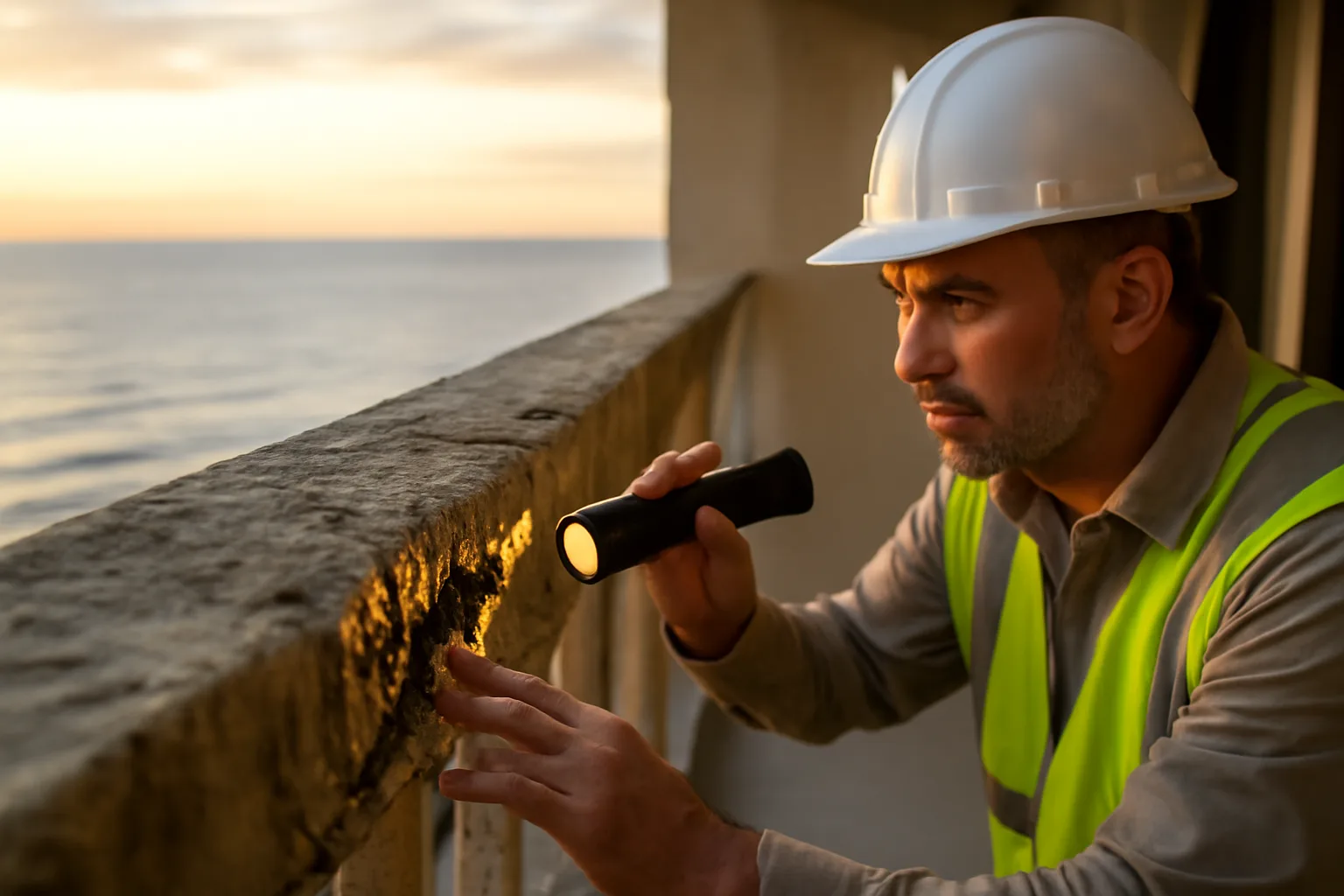
A milestone inspection is a visual (and where needed, more invasive) structural examination performed by a licensed Florida architect or engineer, resulting in a report on the building's structural integrity, according to Fla. Stat. 553.899(1) [1]. The process happens in two phases. Phase 1 is the visual inspection: the engineer or architect walks the building, looks at the concrete, rebar exposure, spalling, cracking, and other visible distress, then files a report. If Phase 1 turns up "substantial structural deterioration," the statute requires a Phase 2 inspection, which can include destructive testing like core sampling or removing sections of stucco or concrete cover to check rebar corrosion directly [1]. The inspector must submit a sealed report to the condo association and to the local building official. Associations then have to distribute a summary to unit owners and post notice in common areas within 21 days of receiving it, and the full report must be posted for members within the required timeframe under the association's records rules [1][3]. If the report flags problems, the board isn't just filing it away: repair work timelines then interact with SIRS-driven reserve funding, because deferred maintenance items identified in a milestone report often become reserve components under the separate SIRS requirement. Cost for the inspection itself varies a lot by building size and complexity. Industry estimates commonly cited in Florida run from roughly $12,000 to $30,000+ for a Phase 1 inspection on a mid-size condo, with Phase 2 (if triggered) costing significantly more depending on the scope of destructive testing. DBPR does not publish a fixed fee schedule for milestone inspections because pricing is a private contract between the association and the licensed engineer or architect [2].
How is SIRS different from the milestone inspection, and do boards need both
Yes, boards need both, and they are legally separate requirements that often get confused. The milestone inspection (553.899) is about structural safety. The Structural Integrity Reserve Study, or SIRS (Fla. Stat. 718.112(2)(g)), is about reserve funding for specific structural components [3]. SIRS applies to condominium associations with buildings 3 stories or more in height and requires a visual inspection of load-bearing walls, primary structural members, floors, roofs, fireproofing, electrical systems, plumbing, foundation, exterior walls, windows, and other components the study author determines material, then a determination of the remaining useful life and cost to replace or maintain each [3]. The study must be performed by a licensed engineer or architect (or in some cases a reserve specialist, depending on how DBPR guidance treats certain components), and the first SIRS deadline was December 31, 2024, for most existing associations [3]. The practical difference: a milestone inspection tells you whether the building is structurally sound right now. A SIRS tells you how much money you need to be setting aside, and by when, for the big-ticket structural items so the association isn't blindsided by a special assessment. For a deeper walkthrough of SIRS mechanics and which components count, see reserve study for condo association and the general reserve study explainer. Many associations commission both in the same season, which is smart, since the engineer walking the building for the milestone inspection can often flag SIRS-relevant deterioration in the same site visit, saving a second scheduling cycle and possibly a second fee.
What is a reserve study, and what is a reserve study for an HOA
A reserve study is a professional assessment of a building's major shared components (roof, paving, pool, elevators, structural elements, and similar) that estimates each component's remaining useful life and the cost to repair or replace it, then converts that into a recommended funding schedule so the association isn't stuck asking owners for emergency cash. For an HOA specifically, a reserve study for HOA purposes covers whatever common elements the association is responsible for maintaining, per its declaration, which is often narrower than a condo's structural components (think: clubhouse, pool, roads, and shared amenities rather than building structure, unless the HOA owns multi-story residential buildings). Florida's SIRS requirement, described above, applies specifically to condominiums and cooperatives with 3+ story buildings, not to typical single-family HOAs, though the 2023-2024 legislative changes did extend some milestone inspection language to certain HOA-owned buildings meeting the height threshold [1][3]. A basic reserve study typically has three deliverables: a physical inventory of components, a condition assessment, and a funding plan (either straight-line, threshold, or component-based funding models). Florida law under Fla. Stat. 718.112(2)(f) already required condo associations to maintain reserve schedules for roof, painting, paving, and any item over $10,000, even before SIRS existed; SIRS made structural components mandatory and non-waivable for qualifying buildings [3]. For a walkthrough built specifically for HOA boards, see hoa reserve study.
How much does a reserve study cost
A basic reserve study for a small to mid-size Florida condo or HOA commonly runs from about $2,000 to $8,000, depending on the number of components, building size, and whether it includes an on-site physical inspection versus a desktop update of a prior study. Larger, high-rise coastal buildings with a full SIRS-level structural component analysis often cost more, sometimes well into five figures, because it requires a licensed engineer's site visit and structural assessment rather than a general reserve specialist's desk review. DBPR doesn't set or publish a statewide fee schedule for reserve studies because, like milestone inspections, it's a private market with fees set by the firm performing the work [2]. Boards should get at least two or three quotes and confirm the preparer's credentials; SIRS specifically requires the study (or at least the structural components of it) be done or overseen by a licensed engineer or architect under Fla. Stat. 718.112(2)(g) [3]. A cheap reserve study that skips a real site visit is usually a bad deal even at a lower price, because the whole point is catching deterioration before it becomes a special assessment. If your board is choosing between a $2,500 desktop update and a $6,000 full site inspection ahead of a milestone year, spend the extra money; the inspection itself will often overlap with the work anyway.
What is an HOA assessment, and what are HOA assessments used for
An HOA assessment is a mandatory fee an association charges its members to cover the costs of maintaining, repairing, and insuring common property, plus building the reserve fund for future big-ticket repairs. There are two basic types: regular (or "annual") assessments, which are the recurring dues built into the yearly budget, and special assessments, which are one-time charges the board levies when the regular budget and reserves aren't enough to cover an unexpected or large expense. What is an assessment, functionally, for a condo owner? It's not optional and it's not the same as a fine. Florida condo associations derive their authority to levy assessments from Fla. Stat. 718.116, which also spells out the association's lien rights if an owner doesn't pay [4]. Special assessments specifically tend to follow milestone inspection findings, SIRS-driven funding shortfalls, insurance premium spikes, or storm damage that exceeds insurance proceeds. Boards that get caught flat-footed on a big special assessment are almost always boards that either skipped a reserve study, waived reserve funding for years (which Florida law now restricts for structural items under SIRS), or didn't budget for the milestone inspection and follow-up repair costs. See hoa special assessment for a full breakdown of how these are calculated and levied, and condo special assessment insurance for how some owners cover unexpected large assessments.
How much should an HOA or condo have in reserves
There's no single statewide dollar figure or percentage Florida law requires; the amount depends entirely on your specific reserve study results for your specific components. What the law does require, for condos with 3+ story buildings, is that reserve funding for SIRS-covered structural components can no longer be waived or reduced below the amount the study recommends, starting with budgets adopted on or after December 31, 2024 [3]. That's a real change from the old system, where many associations legally voted year after year to underfund or fully waive reserves. Fla. Stat. 718.112(2)(f) still allows non-structural reserve items (things not covered by SIRS) to be waived or reduced by a membership vote, but SIRS components are now off-limits for waiver [3]. A rough industry rule of thumb some reserve specialists use is funding reserves to at least 70% of "fully funded" status as a health benchmark, though this isn't a Florida statutory threshold, it's a general reserve-industry practice, and boards shouldn't treat it as a legal requirement. The only number that legally matters for SIRS components is whatever your licensed engineer's study says the components need. For general national context on how other reserve study standards frame funding percentages, see the reserve study guide. If your board hasn't had a reserve study updated in the last 3-5 years, treat that as the first action item, not the special assessment vote.
Are HOA special assessments tax deductible
For most owners, no, a special assessment paid to your HOA or condo association is not tax deductible if the unit is your personal residence, because it's treated like a capital improvement or maintenance cost to your property rather than a deductible expense such as mortgage interest or property tax. There are two narrow exceptions worth knowing. If you own the unit as a rental or investment property, special assessments may be deductible as a business expense or may need to be capitalized and depreciated over time, depending on whether the assessment covers a repair or a capital improvement; that determination depends on IRS rules under 26 U.S.C. 212 and 263, and you should confirm treatment with a CPA, not a board member or property manager. Second, if a portion of the assessment specifically funds a casualty loss repair (like storm damage) and you itemize casualty losses in a federally declared disaster area, a portion might qualify under different IRS casualty loss rules, again something to run past a tax professional. Boards should never advise owners on the tax treatment of assessments directly; that's outside a board's role and creates liability. Point owners to their own CPA or the IRS directly instead.
What changed in Florida condo law recently, and what's still pending
Florida's milestone inspection law started with SB 4-D, passed in a May 2022 special legislative session after the Champlain Towers South collapse in Surfside in June 2021, which killed 98 people [1][5]. That bill created both the milestone inspection requirement and the original version of what became SIRS. Since then, the legislature has made repeated technical fixes. HB 1021 in 2024 clarified reserve funding rules and gave some associations limited relief on how reserve contributions are calculated, and further tweaks arrived in the 2025 session addressing SIRS study timing and milestone inspection phase-in schedules for local governments [6]. Because this area of law keeps getting amended almost every legislative session, any specific deadline or dollar figure quoted in an older news article, including parts of this one, should be checked against the current version of Fla. Stat. Chapter 718 and 553.899 on flsenate.gov before a board relies on it [4]. For a plain-English summary of the reserve fund relief provisions specifically, see florida condo reserve fund relief. Confirm current deadlines with your association's counsel and your county building department; this article reflects the law as understood in mid-2025 and Florida's legislature revisits this topic almost annually.
Where do boards actually go to check their building's specific deadline
Start with your county or municipal building department, since 553.899 puts local building officials in charge of tracking each building's age and setting the actual inspection schedule and notification process [1]. Most Florida counties now have a webpage or portal listing buildings subject to milestone inspection, though the level of detail varies widely county to county. DBPR's Division of Florida Condominiums, Timeshares, and Mobile Homes regulates the association side of the law (SIRS, reserve rules, financial reporting) but does not run the milestone inspection scheduling itself; that's a local building code function, not a state licensing function [2]. Boards sometimes call DBPR first out of habit and get bounced to the county, which wastes time during an already tight deadline window. A practical step-by-step for a board that hasn't started: 1. Pull the certificate of occupancy date from the county property appraiser or building department records. 2. Measure straight-line distance to the coast (25-year vs 30-year trigger). 3. Call the county building official to confirm the local phase-in schedule and any local forms required. 4. Get quotes from at least two licensed engineering firms for Phase 1. 5. Cross-reference with your SIRS timeline so structural findings feed the reserve funding conversation instead of arriving as a surprise later. This is exactly the kind of multi-deadline, multi-agency coordination problem that trips up volunteer boards, since a milestone inspection deadline, a SIRS deadline, and a reserve budget vote can all land in the same 12-month window with three different responsible parties. A $199 one-time Building Compliance Kit exists specifically to help boards organize these dates, generate the owner notices the statute requires, and keep a single calendar instead of three separate spreadsheets; it doesn't replace your engineer or your attorney, it just keeps the paperwork straight.
What happens if a board misses the milestone inspection deadline
Consequences vary by county because enforcement is local, but the general pattern under Fla. Stat. 553.899 is that the local building official can require compliance, and a building found unsafe or with an association that won't comply can face code enforcement action, fines, or in extreme cases an unsafe structure declaration that can force occupants out [1]. Beyond the regulatory risk, there's a practical liability risk for board members personally. Florida courts and the business judgment rule generally protect directors who act reasonably and in good faith, but a board that knowingly ignores a statutory deadline and something goes wrong afterward is in a much worse legal position than a board that tried, documented its efforts, and hit a local scheduling delay. Insurance is the other lever. Some carriers have started asking for milestone inspection and SIRS documentation at renewal, and a lapse can affect an association's ability to renew coverage or can raise premiums, though this varies by carrier and isn't a statutory requirement itself, it's a market response to the same post-Surfside pressure that produced the law. The honest answer for a board that's already late: call your county building department today, get on record as actively pursuing compliance, and get quotes moving. Boards that show a documented good-faith effort are treated very differently than boards that did nothing.
Frequently asked questions
What is the Florida milestone inspection deadline for a 30-year-old condo building?
Buildings 3 or more stories must complete a Phase 1 milestone inspection by December 31 of the year they turn 30 years old, or by 25 years old if within 3 miles of the coast, per Fla. Stat. 553.899. Local building officials set the exact phase-in schedule and enforce compliance, so confirm your building's specific date with your county building department.
What is a reserve study?
A reserve study is a professional evaluation of a building's major shared components (roof, elevators, paving, structural elements) that estimates remaining useful life and replacement cost for each, then produces a funding plan so the association can budget for repairs instead of relying on emergency special assessments.
What is a reserve study for an HOA?
For an HOA, a reserve study covers whatever common elements the association legally maintains under its declaration, which is often amenities, roads, and shared facilities rather than building structure. Florida's SIRS structural reserve requirement applies to condos and co-ops with 3+ story buildings, not typical single-family HOAs, unless the HOA owns qualifying multi-story buildings.
How much should an HOA have in reserves?
There's no fixed statewide dollar amount; it depends on your building's specific components and their condition per a professional reserve study. For SIRS-covered structural items in qualifying Florida condos, the law no longer allows waiving or reducing funding below what the study recommends, starting with budgets adopted after December 31, 2024, under Fla. Stat. 718.112(2)(f).
What is an HOA assessment?
An HOA assessment is a mandatory charge to members that funds common area maintenance, insurance, and reserves. Regular assessments are the recurring annual dues; special assessments are one-time charges levied when the budget or reserves can't cover a large or unexpected cost, such as storm repairs or a SIRS-driven funding shortfall.
How much does a reserve study cost in Florida?
A basic reserve study for a small to mid-size association typically costs $2,000 to $8,000. Buildings needing a full structural reserve study (SIRS) with a licensed engineer's site inspection often cost more, sometimes into five figures, depending on building size and component complexity. DBPR does not set or publish a fixed fee schedule.
Are HOA special assessments tax deductible?
Usually not, if the unit is your primary residence; special assessments are generally treated as capital or maintenance costs, not deductible expenses. Rental property owners may be able to deduct or depreciate a portion depending on IRS rules under 26 U.S.C. 212 and 263. Confirm treatment with a CPA, since this depends on individual circumstances.
What's the difference between a milestone inspection and a SIRS?
A milestone inspection (Fla. Stat. 553.899) checks a building's structural safety at 25 or 30 years and every 10 years after. A SIRS (Fla. Stat. 718.112(2)(g)) is a reserve funding study for structural components, determining remaining useful life and required reserve contributions. They're separate legal requirements, though many associations schedule them together.
Does Florida's SIRS law apply to HOAs or only condos?
SIRS applies to condominium and cooperative associations with buildings 3 stories or higher. Standalone single-family HOAs generally aren't subject to SIRS, though 2023-2024 legislative changes extended some milestone inspection language to certain HOA-owned buildings meeting the height threshold. Confirm applicability with your association's counsel.
Who enforces Florida's milestone inspection deadlines?
Local building officials at the county or municipal level enforce milestone inspection deadlines, not a single state agency. DBPR regulates the association side (SIRS, reserves, financial disclosures) but does not schedule or enforce the structural inspection itself. Always confirm your building's deadline with your county building department directly.
Can a condo association still waive reserve funding in Florida?
Associations can still waive or reduce funding for non-structural reserve items by member vote. As of budgets adopted on or after December 31, 2024, SIRS-covered structural components cannot be waived or funded below the amount the required study recommends, under Fla. Stat. 718.112(2)(f).
What triggered Florida's milestone inspection and SIRS laws?
The Champlain Towers South collapse in Surfside, Florida in June 2021, which killed 98 people, prompted the legislature to pass SB 4-D in a May 2022 special session, creating the statewide milestone inspection requirement and the original structural reserve study framework.
Sources
- Florida Senate, Florida Statutes Section 553.899: Milestone inspection age thresholds, coastal distance rule, phase requirements, and local building official authority
- Florida DBPR, Division of Florida Condominiums, Timeshares, and Mobile Homes: DBPR regulates association-side reserve and financial requirements, not milestone inspection scheduling or fees, which are locally enforced and privately contracted
- Florida Senate, Florida Statutes Section 718.112: SIRS requirement, structural component list, reserve waiver restrictions, and December 31, 2024 compliance deadline
- Florida Senate, Florida Statutes Section 718.116: Legal basis for condo association assessments and lien rights for nonpayment
- NIST National Construction Safety Team Act investigation report, NIST NCSTAR 3-1, Interim Report on the Structural Failure of Champlain Towers South: NIST's federal investigation into the June 2021 Surfside, Florida condominium collapse that killed 98 people
- Florida Senate, Bill Analysis and text for 2024 legislation affecting condominium reserves: 2024 legislative changes (HB/SB 1021) affecting condominium reserve funding calculations and association relief provisions