Last updated 2026-07-25
TL;DR
A reserve study on a condo is an engineering/financial review that estimates the remaining life and replacement cost of major building components, so the association can fund reserves properly. Florida law (Fla. Stat. 718.112) now requires a structural integrity reserve study (SIRS) for condos 3 stories or higher, with the first one due by December 31, 2024 for most buildings.
what is a reserve study on a condo?
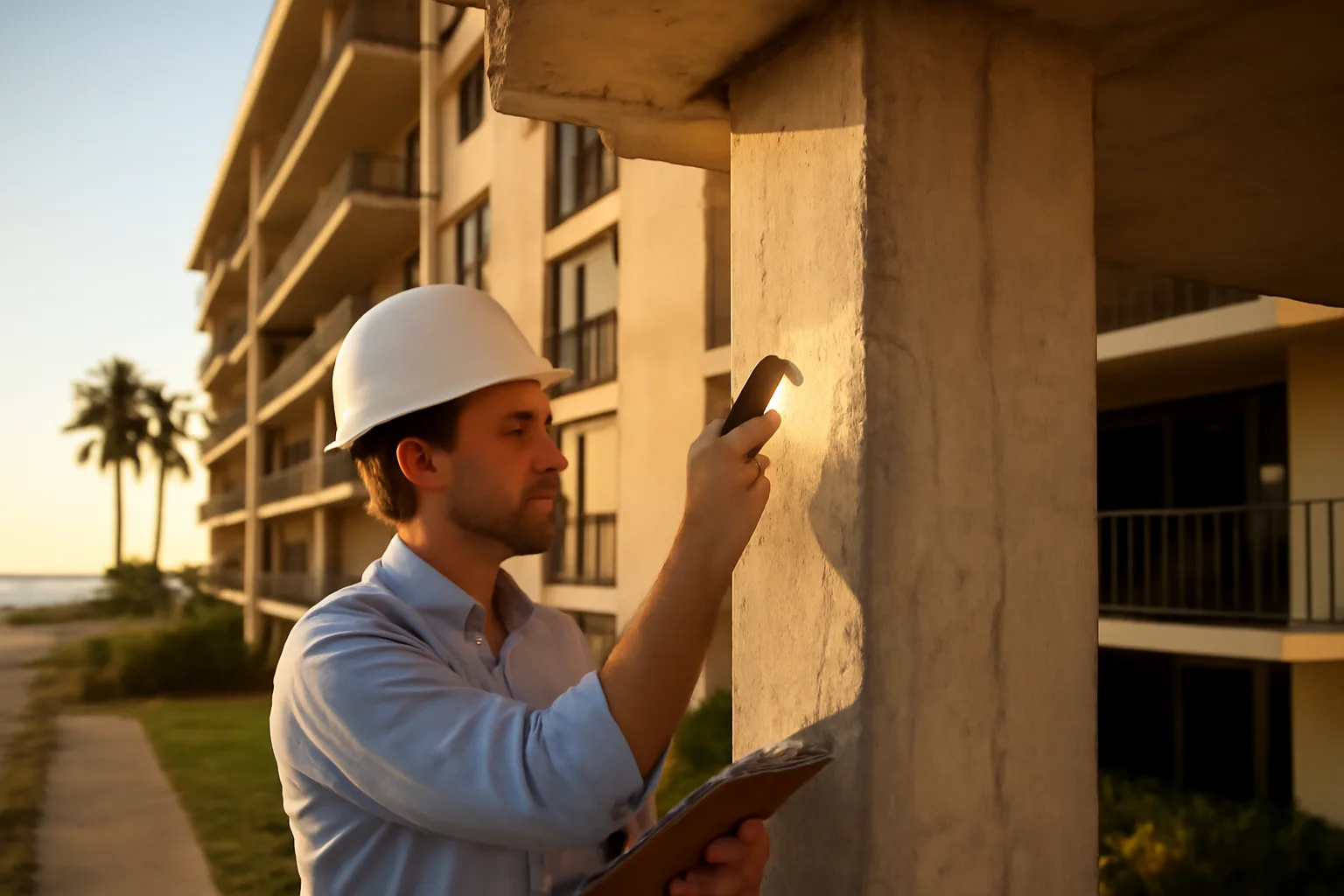
A reserve study on a condo is a professional evaluation of the building's major shared components (roof, paint, pavement, plumbing, structural elements, and in Florida, load-bearing walls, waterproofing, and other structural systems) that estimates how many years each one has left and what it will cost to repair or replace it. The output is a schedule and a funding plan, more than a checklist. Most reserve studies have two halves. The physical analysis inventories the components and estimates remaining useful life, usually based on a site visit, maintenance records, and manufacturer data. The financial analysis then models how much money the association needs to set aside each year, and whether current reserve balances plus planned contributions will cover the projected costs. In Florida, as of the 2022 and 2023 legislative changes following the Champlain Towers South collapse, condo associations with buildings 3 stories or higher must get a specific type of reserve study called a structural integrity reserve study (SIRS), done by a licensed engineer or architect, covering a defined list of structural components [1]. This is narrower and more technical than the older-style "visual reserve study" many associations used voluntarily before 2022, though it overlaps with it heavily. For a full breakdown of what a SIRS covers component by component, see our reserve study for condo association guide.
what is a reserve study for an hoa?
A reserve study for an HOA works the same way conceptually, evaluating shared assets like roads, clubhouses, pools, and drainage systems, and projecting a funding schedule, but it is not governed by the same Florida statute that applies to condominiums. Florida's SIRS mandate under Chapter 718 applies specifically to condominium associations, not homeowners' associations under Chapter 720 [2]. That said, many HOAs commission reserve studies voluntarily, or their governing documents require one, because underfunded reserves are the single most common cause of large special assessments. A homeowners association with a private road system, retention ponds, or a clubhouse roof faces the exact same math a condo does: components wear out on a schedule, and somebody has to pay for the replacement eventually. If you're on an HOA board wondering whether you're required to do one, the honest answer is: check your declaration and bylaws first, because state law doesn't force it the way it does for condos. See our HOA reserve study guide for the practical steps regardless of whether it's mandatory.
what is an hoa assessment (and what is a reserve study funding it)?
An HOA assessment is a fee the association charges owners to cover operating costs and reserve contributions, either as a regular recurring charge or a one-time special assessment when funds fall short. Regular assessments are the routine dues that fund the annual budget, including line items for reserves. Special assessments are extra charges levied when the regular budget and reserve balance can't cover an unexpected cost, like a roof failure or a post-inspection structural repair. A reserve study is the tool that's supposed to prevent boards from needing surprise special assessments in the first place. If the study says the roof needs $400,000 in 8 years and the board funds toward that number every year, the association isn't blindsided when year 8 arrives. Skip the study, or ignore its numbers, and you get the special assessment letters that show up in condo owners' mailboxes with 30 or 60 days' notice. For the mechanics of how special assessments get approved and billed in Florida, see our HOA special assessment explainer.
how much should an hoa (or condo) have in reserves?
There's no single dollar figure or percentage that Florida law requires condos or HOAs to hold in reserves; the requirement is that reserves be funded at a level tied to the actual remaining useful life and replacement cost of each component, calculated by the reserve study itself. That's the "pooled" or "component" method: each item gets its own funding target based on its own timeline. As a rough industry benchmark outside Florida's specific statute, the national trade group Community Associations Institute and various reserve study firms commonly cite a "percent funded" metric, where associations funded below roughly 30% of their ideal reserve level are considered at higher risk of special assessments, though this is an industry rule of thumb, not a legal standard [3]. Florida's post-2022 law doesn't set a specific percent-funded threshold; it requires that reserves for the specific structural components covered by SIRS be funded at 100% of the study's projected need, with no more waiving or underfunding those specific line items starting with the first fiscal year after December 31, 2024 [1]. That's a meaningful change from the old system, where owners could vote every year to waive or reduce reserve funding, including for structural items. That waiver option is now gone for SIRS-covered components in condos 3 stories and up [1]. Non-structural reserve items (painting, paving, general upkeep) can still be waived or reduced by owner vote unless the declaration says otherwise. For HOAs, since there's no statutory funding floor, the honest answer is: whatever your reserve study recommends for your specific components, funded at close to 100% if you want to avoid special assessments, and lower only if your board and owners have explicitly decided to accept that risk with eyes open.
how much does a reserve study cost in Florida?
A reserve study for a condo or HOA in Florida typically costs somewhere between $3,000 and $20,000 or more, depending on the building's size, age, number of components, and whether it's a full SIRS with structural engineering work or a simpler financial-only update. A small, straightforward building might come in near the low end; a large high-rise with complex structural systems, multiple parking structures, and waterfront exposure will run well above that. Several factors drive the price up or down: the number of units and buildings, whether it's a first-time study or an update to an existing one (updates cost less because the physical inventory already exists), how many structural components require an engineer's sign-off versus a general reserve specialist's estimate, and geographic accessibility (a remote or hard-to-schedule site visit costs more). A SIRS specifically must be performed by a licensed engineer or architect in Florida, per the statute, which is a narrower (and often pricier) credential requirement than a general reserve study, which can sometimes be done by a reserve specialist without an engineering license for non-structural items [1]. Boards should get at least two or three quotes and confirm the provider's license status through DBPR before signing a contract. DBPR, the Florida Department of Business and Professional Regulation, is also the agency that licenses community association managers and handles complaints against them, so it's worth checking a manager's or firm's status there before you commit funds.
are hoa special assessments tax deductible?
For most individual condo or HOA unit owners, special assessments are generally not tax deductible, because the IRS treats them like a capital improvement to your property rather than a deductible expense, similar to how regular HOA dues aren't deductible for a primary residence. IRS Publication 527 draws this line based on whether the assessment is for a repair (potentially deductible in specific circumstances for rental property) versus a capital improvement (added to your cost basis, not immediately deductible) [4]. There are exceptions. If the unit is a rental property, a portion of assessments tied to repairs and maintenance may be deductible as a business expense in the year paid, while assessments for improvements that add value or extend the property's life typically get added to the property's basis and recovered later through depreciation or when you sell [4]. If you use part of your unit for a home office, or if a special assessment happens to be earmarked for casualty-loss repairs after a federally declared disaster, there can be narrow deductions available under specific IRS rules. This is genuinely one to run past a CPA, not a board member or a blog. The line between "repair" and "improvement" for tax purposes doesn't always match how the board describes the assessment in its own resolution, and getting it wrong on a return can trigger an amended filing later.
what components does a Florida SIRS actually have to cover?
Florida's structural integrity reserve study statute requires the study to address, at minimum: roof, load-bearing walls or other primary structural members and primary structural systems, floor, foundation, fireproofing and fire protection systems, plumbing, electrical systems, waterproofing and exterior painting, windows, and any other item that has a deferred maintenance expense or replacement cost exceeding $10,000 and that affects the habitability of the building [1]. That $10,000 threshold matters because it sweeps in components boards might not think of as "structural" in the everyday sense, like major electrical panel replacements or large-scale window and door systems, if the cost estimate clears that bar. The statute's language, straight from Fla. Stat. 718.112(2)(g), requires the association to "obtain a structural integrity reserve study for each building on the condominium property that is three stories or more in height" covering those specific components [1]. Boards sometimes assume a general reserve study they already commissioned covers this requirement. It might not, if it wasn't performed to the SIRS-specific standard or wasn't done by a licensed engineer or architect for the structural items. Confirm with your reserve provider, and separately with your association's counsel, that what you're paying for actually satisfies the statutory list, more than a generic reserve update.
when is the SIRS deadline, and what happens if a condo misses it?
Most Florida condominium associations with buildings 3 stories or higher had to complete their first structural integrity reserve study by December 31, 2024, and must fund the SIRS-covered reserve items in full starting with the fiscal year beginning after that date, unless the legislature extends the deadline for specific buildings [1]. Some associations that were still working through milestone inspection deadlines got informal accommodation discussions in Tallahassee, but boards should not assume an extension applies to their building without confirming directly. Missing the deadline doesn't come with a single, uniform statutory penalty spelled out as a fine schedule in the way a building code violation might, but it creates real exposure: it can affect the association's ability to get certain insurance, can be used against the board in a breach-of-fiduciary-duty claim from owners, and can complicate unit sales, since Florida law increasingly requires disclosure of SIRS status and reserve funding to prospective buyers. The deadline situation has shifted more than once since 2022, with amendments adjusting timelines for milestone inspections and reserve studies. Confirm the current deadline for your specific building with your association's counsel and your county building department, because relying on a 2023 news article for a 2026 deadline is exactly how boards get caught flat-footed.
how does a SIRS relate to the milestone inspection?
A milestone inspection and a SIRS are two separate, related requirements under Florida law: the milestone inspection is a one-time (then recurring every 10 years) structural safety check by a licensed engineer or architect, while the SIRS is the financial planning document that estimates reserve funding needs for structural components. Buildings 3 stories or higher must get a milestone inspection by the end of the year they turn 30 (or 25 if within 3 miles of the coast), then every 10 years after that, under Fla. Stat. 553.899 [5]. In practice, boards often try to schedule these together, or at least have the same engineering firm handle both, because the physical inspection data from the milestone report feeds directly into the SIRS's estimates of remaining useful life for structural components. It's not legally required that the same firm do both, but it's usually more efficient and can reduce redundant site visits. If your building is approaching either deadline and you're not sure which applies first, or whether you need both simultaneously, that's a scheduling and document-organization problem as much as an engineering one. Coordinating engineer contracts, reserve study timing, and owner notices in the right sequence is exactly the kind of task a $199 one-time Board Compliance Kit is built to organize, though the actual inspection and study still have to be performed by the licensed professionals the statute requires.
can an association waive or reduce reserve funding?
Florida condo associations can no longer waive or reduce reserve funding for the specific structural components covered by a SIRS, starting with the first fiscal year after December 31, 2024; that waiver option, which used to require only a majority owner vote at a meeting, is now eliminated by statute for those line items [1]. Non-structural reserve components (like general painting or resurfacing not tied to the SIRS list) can still potentially be waived or reduced by a vote of the membership, depending on the association's specific circumstances and any further amendments to Chapter 718. This is a real shift from how Florida condos operated for decades. Plenty of associations kept reserves artificially low for years by voting to underfund or waive them entirely, which kept monthly assessments lower in the short term but set up exactly the kind of six-figure special assessment scenarios that became national news after 2021. HOAs under Chapter 720 aren't subject to this same SIRS waiver restriction, since the requirement itself doesn't apply to them, so HOA boards and their attorneys need to look at their own declaration's language on reserve waivers rather than assuming the condo rules apply.
is there any relief or extension available for reserve funding?
Florida has periodically considered, and in some cases passed, limited relief measures for condo associations struggling to meet the full SIRS funding and milestone inspection timelines, including discussions around allowing pooled reserve accounts, phased funding, or short-term financing options, but these change frequently and vary by legislative session. Boards should not assume a relief provision applies to their building without checking current law. Some associations have pursued bank loans or lines of credit specifically to spread out large structural repair costs instead of a single lump-sum special assessment, which can ease the immediate cash burden on owners though it adds interest costs over time. Others have looked at whether their county or municipality offers any assistance programs, though these are inconsistent and not guaranteed statewide. For the latest on what relief options exist and how they interact with reserve funding requirements, see our Florida condo reserve fund relief page, and confirm anything you read there with your association's counsel before budgeting around it, since this is one of the fastest-moving areas of Florida condo law right now.
who actually performs the reserve study, and how do boards choose one?
For a Florida SIRS, the statute requires the structural components to be evaluated by a licensed engineer or architect; the financial and non-structural portions of a broader reserve study can sometimes be handled by a qualified reserve specialist without an engineering license, though many firms now offer both under one roof [1]. Boards should verify any engineer's or architect's license status directly through DBPR before signing a contract. When comparing providers, ask for: a sample report from a similarly sized building, a clear breakdown of what's included versus billed as an add-on, their timeline for site visits and report delivery, and whether the physical inventory portion requires access to individual units or just common areas. A rushed or superficial site visit produces a report that understates costs, which is worse than not having a study at all because it gives the board false confidence. Boards juggling a SIRS, a milestone inspection, and a regular reserve study renewal all at once often lose track of which contract covers what and when reports are due to owners. That's the specific gap a Board Compliance Kit is meant to close: it organizes the deadlines, contracts, and owner communications around these studies, while the licensed engineer or architect does the actual technical work the statute requires.
Frequently asked questions
What is a reserve study?
A reserve study is a professional assessment that inventories a building's major shared components, estimates each one's remaining useful life and replacement cost, and produces a funding schedule so the association can save the right amount each year instead of getting hit with surprise special assessments.
What is a reserve study for an HOA?
It's the same type of physical and financial assessment used for condos, but applied to HOA common assets like roads, clubhouses, and drainage systems. Florida doesn't legally require it for HOAs the way it does for condos 3+ stories, so check your declaration for any requirement.
What is an HOA assessment?
An HOA assessment is a fee the association charges owners, either as regular recurring dues covering operating costs and reserves, or as a one-time special assessment when the budget and reserves can't cover an unexpected or underfunded cost like a roof replacement or structural repair.
How much should an HOA have in reserves?
There's no fixed dollar amount; it depends on the reserve study's component-by-component projections. Industry benchmarks sometimes flag associations funded below roughly 30% of their calculated ideal as higher-risk for special assessments, but the right number is specific to your components and their remaining life.
How much does a reserve study cost?
In Florida, expect roughly $3,000 to $20,000 or more, depending on building size, number of components, whether it's a first-time study or an update, and whether structural items require a licensed engineer's sign-off for a SIRS. Get at least two or three quotes.
Are HOA special assessments tax deductible?
Generally no, for a primary residence, because the IRS typically treats special assessments as capital improvements added to your cost basis rather than a deductible expense. Rental property owners may deduct repair-related portions in the year paid; check with a CPA for your specific situation.
Does Florida require a reserve study for condos?
Florida requires a structural integrity reserve study (SIRS) for condo buildings 3 stories or higher, under Fla. Stat. 718.112, with most associations needing their first one completed and full structural reserve funding starting after December 31, 2024.
What's the difference between a reserve study and a SIRS?
A SIRS is a specific, narrower type of reserve study required by Florida law, covering only structural components (roof, load-bearing walls, foundation, plumbing, electrical, waterproofing, and similar) and requiring a licensed engineer or architect. A general reserve study can cover a wider range of components without that licensing requirement.
Can an HOA or condo waive reserve funding in Florida?
Condos can no longer waive funding for SIRS-covered structural components starting with fiscal years after December 31, 2024. Non-structural reserve items can still potentially be waived by owner vote. HOAs aren't subject to the SIRS waiver rule since the requirement doesn't apply to them under Chapter 720.
How often does a condo need a new reserve study or SIRS in Florida?
The statute requires the SIRS to be updated at least every 10 years, aligned with the milestone inspection cycle, though associations often update the financial projections more frequently as costs and component conditions change.
Who can perform a structural integrity reserve study in Florida?
The structural components must be evaluated by a licensed engineer or architect. Verify any provider's license status directly through Florida's Department of Business and Professional Regulation (DBPR) before signing a contract.
What happens if a condo association skips its required SIRS?
There's no single statutory fine listed in the law itself, but skipping it creates exposure: insurance complications, potential breach-of-fiduciary-duty claims from owners, and disclosure problems for unit sales, since buyers increasingly need SIRS and reserve-funding status disclosed to them.
Sources
- Florida Senate, Florida Statutes Chapter 718.112: Structural integrity reserve study (SIRS) requirements, covered components, deadlines, and elimination of waivers for structural reserve items in condos 3+ stories
- Florida Senate, Florida Statutes Chapter 720: Homeowners' associations are governed under Chapter 720, separate from the condominium SIRS requirement in Chapter 718
- Community Associations Institute, reserve funding guidance: Industry benchmark that associations funded below roughly 30% of ideal reserve levels face higher risk of special assessments
- IRS, Publication 527 (Residential Rental Property): IRS guidance distinguishing deductible repairs from capital improvements for rental property, relevant to whether special assessments are deductible
- Florida Senate, Florida Statutes Section 553.899 (Milestone inspections): Milestone inspection requirement for buildings 3+ stories, due by year 30 (or 25 if within 3 miles of coast) and every 10 years after