Last updated 2026-07-25
TL;DR
A structural integrity reserve study (SIRS) is a state-mandated inspection of a condo building's structural components (roof, load-bearing walls, waterproofing, plumbing, and more) that sets no-waiver reserve funding levels. Key Largo buildings 3 stories or taller, certified occupied before July 1, 2022, needed their first SIRS by December 31, 2024, under Florida Statute 718.112(2)(g) [1]. Costs typically run $5,000 to $15,000+ depending on building size and number of components inspected.
What is a reserve study, and why does Key Largo need one now?
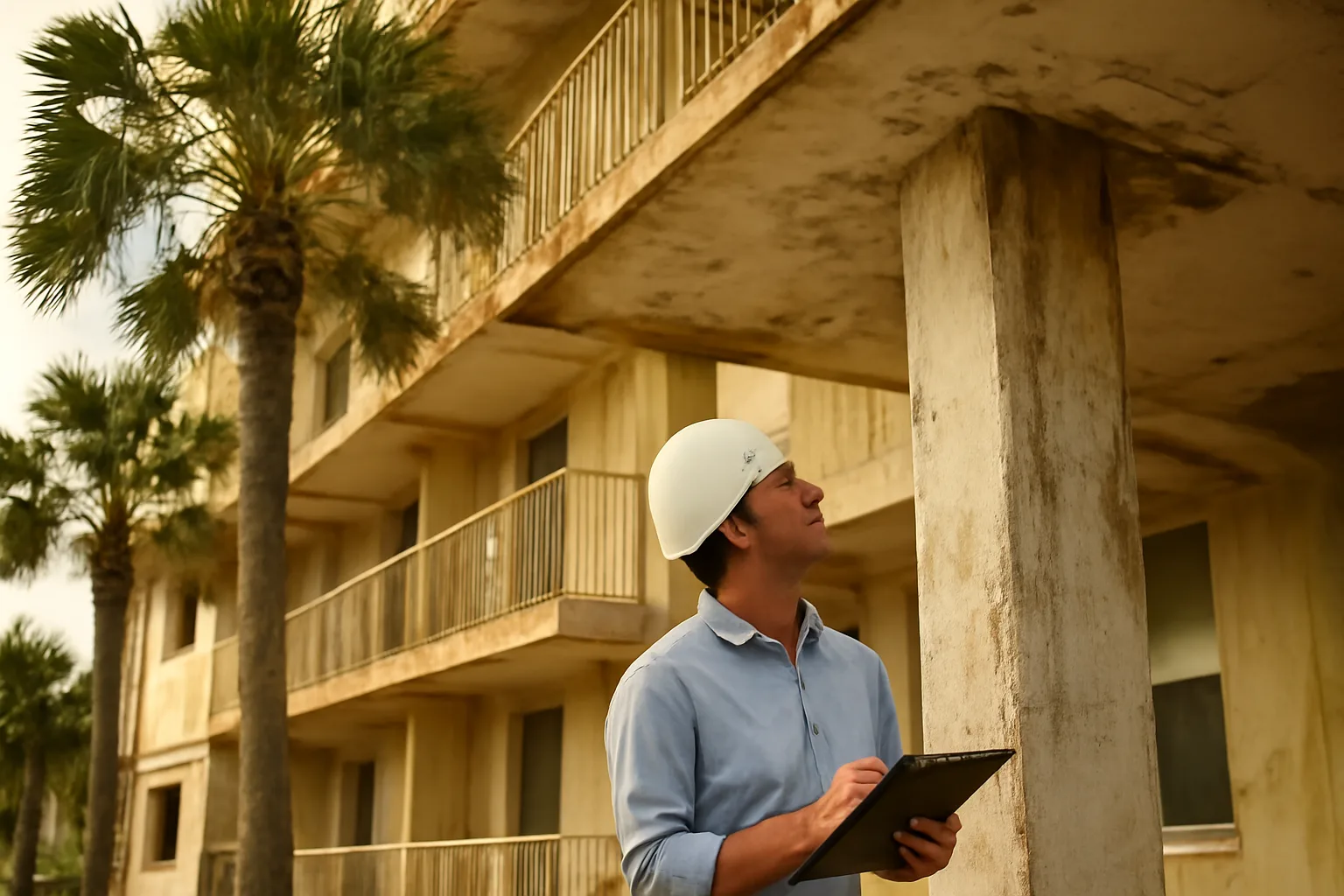
A reserve study is a professional assessment of a building's major components (roof, structure, plumbing, paving, painting, and so on) that projects when each one needs replacement and how much money the association should be setting aside every year to pay for it without a surprise bill. For a Florida condo, the version that matters most right now is the Structural Integrity Reserve Study, or SIRS, created by Florida Statute 718.112(2)(g) after the Champlain Towers South collapse in Surfside in June 2021 [1]. Key Largo sits in unincorporated Monroe County, right on the water, with plenty of buildings from the 1970s, 80s, and 90s that are now 3 stories or taller and squarely inside the SIRS mandate. Salt air, humidity, and storm surge exposure make the Keys some of the harder places in Florida to keep concrete and rebar in good shape, so this isn't a paperwork exercise for coastal buildings like these. It's an actual engineering look at what's holding the building up. The law required condo and cooperative associations with buildings 3 stories or more, first certified for occupancy before July 1, 2022, to complete their first SIRS by December 31, 2024 [1]. Buildings certified for occupancy after that date get their first SIRS due 25 years after certification, or 30 years if the building is within 3 miles of the coastline, and every 10 years after that [1]. Because nearly all of Key Largo is coastal, that 30-year clock applies to most newer buildings there. If your association missed the December 2024 deadline, don't panic and don't guess. Get a licensed engineer or architect under contract now and document the timeline. DBPR has enforcement authority over condo associations under Chapter 718 [2], and county building officials can also weigh in on life-safety concerns. Confirm the current status of your building's deadline and any grace period with your association's counsel, since legislative sessions have already amended parts of this law once (SB 4-D in 2022, then further tweaks in 2023 and 2024) and could do so again.
What is a reserve study for an HOA, and does it differ from a condo SIRS?
A reserve study for an HOA (a homeowners association, usually single-family homes or townhomes rather than condominiums) is the same basic idea, projecting future repair and replacement costs for shared components like roads, pools, clubhouses, and fencing, and setting an annual reserve contribution. But the legal requirement is different. The SIRS mandate under Florida Statute 718.112 applies specifically to condominium associations (and cooperatives under a parallel provision), not to HOAs [1]. Most single-family HOAs in the Keys don't own 3-story residential buildings, so they generally fall outside SIRS. That said, many HOAs still voluntarily commission reserve studies because underfunded reserves are the single biggest cause of unexpected special assessments, and lenders increasingly ask for reserve documentation before approving mortgages in the community. If your HOA has any 3-story-plus condo-style buildings or common structures with structural components, get clarity from counsel on whether Chapter 718 or Chapter 720 (the Homeowners' Association Act) governs your reserves, because the funding rules aren't identical. For a broader walkthrough of standard reserve mechanics outside the SIRS-specific rules, see our reserve study and HOA reserve study guides.
What is an HOA assessment, and how is it different from a special assessment?
An HOA assessment is the regular fee owners pay to fund the association's operating budget and reserves, usually billed monthly or quarterly. A special assessment is different. It's a separate, often larger, one-time charge levied when the regular budget and reserves can't cover an unexpected or large expense, like a new roof after storm damage, a seawall repair, or a structural fix flagged by a milestone inspection or SIRS. Under Florida law, condo boards generally have authority to levy special assessments for expenses not anticipated in the annual budget, subject to notice requirements in the association's bylaws and Chapter 718 [1]. In Key Largo, where storm and flood exposure is high, special assessments tend to follow two triggers: hurricane damage claims that exceed insurance payouts, and SIRS findings that reveal deferred maintenance nobody budgeted for. Boards should give owners as much advance notice as possible, even when the statute's minimum notice period is shorter, because a $15,000 special assessment landing with 14 days' notice creates real hardship and real anger at board meetings. For more on how these get structured and communicated, see HOA special assessment.
How much should an HOA (or condo) have in reserves?
There's no single dollar figure that applies to every building, because it depends entirely on the age, size, number of components, and condition of your specific property. But Florida law removed the option to waive or underfund reserves for the SIRS-covered components starting with each association's first SIRS-informed budget. Specifically, Florida Statute 718.112(2)(f) prohibits condo associations from voting to waive or reduce reserve funding for the components identified in a SIRS (roof, load-bearing walls, primary structural members, floor, foundation, fireproofing, plumbing, electrical, waterproofing, and exterior painting, among others) once that study is complete [1]. Reserves for those items must be funded based on the study's findings, calculated using either the straight-line or pooled (cash flow) method, at full actuarial funding, no more discretion to defer. A useful rule of thumb from the reserve-study industry: underfunded reserves (below roughly 30% funded relative to full funding) correlate strongly with a higher likelihood of a special assessment within 5 years, according to reserve specialists and the legislative record that prompted the 2022 reform. There's no single peer-reviewed national dataset pinning that percentage precisely, so treat it as directional, not gospel, and lean on your own SIRS numbers instead of a generic benchmark. For Key Largo buildings specifically, expect the SIRS-driven numbers to run higher than inland Florida comparables. Concrete restoration and structural steel work in a marine environment costs more and needs doing more often, and that shows up directly in the funding schedule your engineer hands the board.
How much does a reserve study (or SIRS) cost in the Keys?
| Standard HOA reserve study | $3,000 - $10,000 | Reserve specialist/analyst | Voluntary, or per governing docs |
|---|---|---|---|
| SIRS (condo, 3+ stories) | $5,000 - $15,000+ | Licensed engineer or architect | FL Stat. 718.112(2)(g) [1] |
| Milestone inspection | Often bundled or separate, varies by sq ft | Licensed engineer or architect | FL Stat. 553.899 [3] |
For a standard, voluntary HOA-style reserve study, costs commonly range from $3,000 to $10,000 depending on the number of components and site visits required, based on typical industry ranges reported by reserve study providers nationally (there's no single Florida-specific government price survey, so treat this as a market range, not a regulated fee). A SIRS costs more because it requires a licensed engineer or architect to perform a visual inspection of specific structural components and produce a report meeting the statutory content requirements in 718.112(2)(g) [1]. For Florida condos generally, SIRS costs run roughly $5,000 to $15,000 for a mid-size building, climbing higher for large or complex high-rises, or for buildings that also need a parallel milestone inspection under Florida Statute 553.899 [3]. Key Largo buildings often cost more on both counts. Coastal, single-access-road locations mean fewer local engineering firms bid the work, mobilization costs are higher, and structures closer to the water frequently show more advanced corrosion or spalling that requires additional destructive or semi-destructive testing beyond the baseline visual review. Get at least two or three quotes from Florida-licensed engineers or architects, and ask each one explicitly whether their price includes the milestone inspection's required work too, since bundling the two can save real money versus hiring separately. | Study type | Typical cost range | Who performs it | Legal basis |
How does a milestone inspection relate to the SIRS in Key Largo?
A milestone inspection and a SIRS are two separate but related requirements, and Key Largo buildings often need both around the same time. A milestone inspection under Florida Statute 553.899 is a structural safety inspection required for condo and cooperative buildings 3 stories or more, due at 30 years of age (or 25 years if within 3 miles of the coast) and every 10 years after [3]. A SIRS is the reserve-funding study under 718.112(2)(g) that looks at specific building components and sets aside money for their eventual repair or replacement [1]. Because nearly all Key Largo condo buildings sit within 3 miles of the coastline, the 25-year milestone trigger applies rather than the 30-year one that inland buildings get [3]. That's an earlier deadline than a lot of boards assume when they're comparing notes with friends in Orlando or Tampa condos. Many engineering firms will scope both inspections in a single site visit since the physical inspection overlaps substantially, even though the two produce separate reports with separate statutory content requirements. Ask your engineer directly whether they're licensed and experienced doing both, and get the scope and deliverables in writing before signing anything.
Are HOA special assessments tax deductible?
Generally, no, not for the individual homeowner claiming a personal itemized deduction, and this trips up a lot of owners after a big SIRS-driven assessment hits. The IRS treats HOA assessments, including special assessments, as a personal living expense similar to rent, not a deductible tax payment, because you're paying for maintenance and improvement of property you own, not a tax to a government entity [4]. There are two narrow exceptions worth knowing. If the unit is a rental property, the owner can typically deduct HOA assessments (regular and special) as a rental expense against rental income, per general IRS rules on rental property expenses in Publication 527 [4]. And if a special assessment funds a capital improvement to a rental property (like a new roof) rather than a repair, it may need to be depreciated over time rather than deducted immediately, again per Publication 527 guidance [4]. For an owner-occupied primary residence or second home, don't count on the special assessment reducing your tax bill. Talk to a CPA who knows Florida condo taxation specifics before assuming anything, especially if your assessment gets paid via a loan with its own interest deduction question attached.
What triggers a special assessment after a SIRS in a Key Largo condo?
The most common trigger is straightforward: the SIRS finds deferred maintenance or component degradation that the association's existing reserves don't cover, and the board has no legal ability to defer funding for those specific components anymore under 718.112(2)(f) [1]. If the reserve balance for, say, the roof or the concrete structural members is far short of what the study says is needed, the board typically has two choices: raise regular assessments sharply, or levy a special assessment to close the gap faster. In Key Largo specifically, saltwater intrusion into concrete (chloride-induced corrosion of rebar) is a very common finding in older buildings, and it's expensive to fix properly, often running into six figures for a mid-size building's full structural remediation. Waterproofing failures around balconies and exterior walls, common in older Keys construction that wasn't built to today's coastal building code standards, is another frequent and costly finding. Boards facing this should get bids from multiple licensed contractors, verify their own insurance policy actually covers a special assessment gap (some do, through condo association special assessment coverage riders), and communicate the numbers to owners early and often. See condo special assessment insurance for how that coverage typically works, and reserve study for condo association for how the SIRS numbers should flow into next year's budget.
Is there any relief available if reserves can't cover the SIRS numbers?
Yes, somewhat, though the relief is narrower than a lot of boards hope. The Florida legislature has adjusted the original 2022 reform (SB 4-D) more than once since, including provisions letting some associations get limited extensions or alternative funding structures under certain conditions, and 2023's SB 154 clarified some of the funding mechanics further. For the current, exact rules on any extension, phased funding, or line-of-credit option your specific association might qualify for, don't rely on secondhand summaries, including this one. Confirm directly with your association's counsel and, where relevant, Monroe County building officials, since the statute has changed multiple times since 2022 and will likely change again. Our florida condo reserve fund relief page tracks the general landscape, but statute-specific verification with counsel is the only safe move before a board makes a funding decision based on assumed relief.
How should a Key Largo board actually get this done?
Start by confirming your building's exact age, occupancy certification date, and distance from the coastline, because those three facts determine your deadlines under both 553.899 and 718.112(2)(g) [1][3]. Then get bids from at least two Florida-licensed engineering or architecture firms for the SIRS and milestone inspection together, and ask each one for a written timeline, since firms serving the Keys are often booked out weeks or months given limited local capacity. Once the reports land, the board's job shifts to funding math: comparing current reserve balances against the SIRS-required no-waiver funding levels, and deciding between raising regular assessments, levying a special assessment, or a mix of both. Document every decision in board minutes, since owners have a right to see the reasoning, and disputes over special assessments are one of the most common sources of litigation against Florida condo boards. This is also where a lot of boards get overwhelmed just tracking deadlines, vendor contracts, and owner notices across multiple overlapping statutes. If your board wants a structured way to organize the SIRS, milestone inspection, and reserve deadlines specific to your building's age and coastal distance, along with owner notice templates, our $199 one-time Board Compliance Kit is built for exactly that. It doesn't replace your engineer or your attorney, and it makes zero compliance determinations about your building. It organizes what the licensed professionals produce, schedules the recurring deadlines, and helps you communicate clearly with owners.
Frequently asked questions
What is a reserve study?
A reserve study is a professional analysis that identifies a building's major components (roof, structure, plumbing, paving, and similar), estimates their remaining useful life and replacement cost, and calculates the annual funding an association needs to set aside to pay for those replacements without a surprise special assessment.
What is a reserve study for an HOA?
For an HOA, a reserve study covers shared community assets like roads, pools, clubhouses, and fencing rather than condo building components. It's generally voluntary for HOAs under Chapter 720, unlike the mandatory SIRS that applies to condo associations under Florida Statute 718.112(2)(g) [1].
What is an HOA assessment?
An HOA assessment is the regular fee, usually monthly or quarterly, that owners pay to fund the association's operating budget and reserve accounts. It's distinct from a special assessment, which is a one-time, often larger charge levied to cover an unexpected or underfunded expense.
What are HOA assessments used for?
Regular HOA assessments fund day-to-day operating costs (landscaping, insurance, management fees) and contribute to reserve accounts for future big-ticket replacements. Special assessments cover gaps when reserves and the operating budget can't absorb an unexpected cost, like storm damage or a SIRS-driven structural repair.
How much should an HOA have in reserves?
There's no universal dollar figure; it depends on your building's age, size, and components. For Florida condos, the SIRS now legally requires full funding (no waivers) for structural components once the study is complete, under Florida Statute 718.112(2)(f) [1]. HOAs without SIRS obligations should still aim for full or near-full funding based on their own reserve study's findings.
How much does a reserve study cost?
A standard voluntary reserve study for an HOA typically runs $3,000 to $10,000 based on common industry pricing. A Florida condo's SIRS, performed by a licensed engineer or architect, typically costs $5,000 to $15,000 or more depending on building size and component count.
Are HOA special assessments tax deductible?
Generally no, for an owner-occupied home the IRS treats HOA assessments, including special ones, as a nondeductible personal expense. If the unit is a rental property, the assessment may be deductible (or depreciable, if it funds a capital improvement) as a rental expense under IRS Publication 527 [4]. Confirm specifics with a CPA.
When was the first SIRS deadline for Key Largo condos?
Condo and co-op buildings 3 stories or taller, certified for occupancy before July 1, 2022, needed their first SIRS completed by December 31, 2024, under Florida Statute 718.112(2)(g) [1]. Buildings certified after that date get 25 years (30 if within 3 miles of the coast) before their first SIRS is due.
Does the 25-year or 30-year milestone rule apply to Key Largo?
Since nearly all of Key Largo sits within 3 miles of the coastline, most buildings there fall under the 25-year milestone inspection trigger rather than the 30-year inland trigger, per Florida Statute 553.899 [3]. Confirm your building's exact distance and status with a licensed surveyor or your association's engineer.
What components does a SIRS have to cover?
Florida Statute 718.112(2)(g) requires the SIRS to address at minimum the roof, load-bearing walls and primary structural members, floor, foundation, fireproofing and fire protection systems, plumbing, electrical systems, waterproofing and exterior painting, and windows and exterior doors [1]. The licensed engineer or architect performing the study determines the specific findings and remaining useful life for each.
Can a Key Largo condo board vote to waive SIRS-related reserves?
No. Florida Statute 718.112(2)(f) prohibits waiving or underfunding reserves for the components identified in a completed SIRS. Boards and owners no longer have the option to vote down full funding for those structural items, unlike non-SIRS reserve line items which may still allow reduced funding by owner vote [1].
Who is qualified to perform a SIRS in Florida?
A SIRS must be performed by a licensed engineer or licensed architect authorized to practice in Florida. DBPR oversees condo association compliance and licensing standards under Chapter 718 [2]. Boards should verify the professional's active Florida license before signing a contract.
Sources
- Florida Legislature, Florida Statute 718.112: SIRS deadline, required components, and no-waiver reserve funding rule for condo associations
- Florida DBPR, Division of Florida Condominiums, Timeshares, and Mobile Homes: DBPR regulatory oversight of Florida condominium associations under Chapter 718
- Florida Legislature, Florida Statute 553.899: Milestone inspection deadlines at 30 years (25 years if within 3 miles of coastline) and every 10 years after
- IRS, Publication 527 (Residential Rental Property): Tax treatment of HOA assessments and special assessments for rental versus personal-use property
- Florida Senate, SB 4-D (2022), Building Safety: Origin of the 2022 SIRS and milestone inspection reform enacted after the Champlain Towers South collapse
- Florida Senate, SB 154 (2023), Community Associations: 2023 legislative amendments clarifying SIRS funding mechanics and association compliance timelines