Last updated 2026-07-25
TL;DR
A structural integrity reserve study (SIRS) is a Florida-mandated inspection of a condo building's structural components (roof, load-bearing walls, waterproofing, and more) used to calculate full, non-waivable reserve funding under Fla. Stat. 718.112. Buildings 3+ stories needed their first SIRS by December 31, 2024, with reserves fully funded starting the 2025 budget year.
What is a reserve study?
A reserve study is a professional evaluation of an association's shared components, their remaining useful life, and the cost to repair or replace them, used to set how much money the association should be setting aside each year. Think of it as a long-range maintenance budget backed by inspection data instead of guesswork. A standard (non-structural) reserve study usually looks at everything: paint, pavement, pools, elevators, roofs, plumbing. A structural integrity reserve study (SIRS) is a narrower, Florida-specific version created by SB 4-D after the Champlain Towers South collapse in Surfside in June 2021. SIRS covers only the load-bearing and life-safety-adjacent structural items listed in statute, not cosmetic ones [1]. For a Hollywood building, whether you're near the beach on North Ocean Drive or further inland along Hollywood Boulevard, the SIRS requirement is the same. Florida law does not carve out exceptions for distance from saltwater, though coastal exposure absolutely affects what the inspector finds and how fast components degrade. See our fuller breakdown of the reserve study process if you want the mechanics beyond SIRS specifically.
What is a reserve study for an HOA versus a condo SIRS?
This is where a lot of Hollywood boards get confused, and understandably so. Homeowners associations (HOAs) with single-family homes are not subject to the SIRS requirement at all. SIRS under Fla. Stat. 718.112(2)(g) applies specifically to condominium associations with buildings that are three stories or more in height [1]. Cooperatives got a parallel requirement under Fla. Stat. 719.106 [2]. So "what is a reserve study for an HOA" and "what is a structural integrity reserve study" are really two different questions with two different answers. A generic HOA reserve study (for a townhome community with a clubhouse and a pool, say) is a voluntary or documents-required financial planning tool. A condo SIRS is a statutory mandate with specific inspector qualifications, specific components, and a specific reporting format that goes to DBPR's Division of Florida Condominiums, Timeshares, and Mobile Homes [3]. If your association is an HOA with attached townhomes that happen to be three stories, check your specific structure type with counsel. The statute's language turns on being a "condominium association" governed by chapter 718, not simply on building height. Our HOA reserve study explainer covers the non-condo side in more depth.
What does a SIRS actually inspect?
By statute, a SIRS must be performed by a licensed engineer or architect and must at minimum address: roof, load-bearing walls or other primary structural members, floor, foundation, fireproofing and fire protection systems, plumbing, electrical systems, waterproofing and exterior painting, windows, and "any other item that has a deferred maintenance expense or replacement cost that exceeds $10,000 and the failure to replace or maintain such item negatively affects" the items above [1]. The report has to state the estimated remaining useful life and estimated replacement cost (or deferred maintenance cost) of each component, then feed those numbers into the reserve schedule. That's the real teeth of the law: the board can no longer vote to waive or reduce reserves for these specific components, per Fla. Stat. 718.112(2)(f)(3) [1]. Full funding for SIRS-covered items became mandatory starting with the association's first fiscal year budget adopted on or after December 31, 2024 [1]. One nuance worth flagging: the statute technically requires the SIRS to be "based on" or "performed as part of" a milestone inspection where one is due, but many older buildings had a SIRS done on its own timeline before a milestone inspection was triggered. If your Hollywood building hasn't had either yet, talk to your engineer about sequencing them together to save on mobilization and access costs.
When was the Hollywood SIRS deadline, and what happens now?
The statewide deadline for the first SIRS, for condo buildings 3 stories or higher regardless of location, was December 31, 2024 [1]. That deadline has passed. If your Hollywood association hasn't completed one, you are past the statutory line, and the next steps are to get it done immediately and document why it's late for your members and, if needed, DBPR. After the first SIRS, the law requires a new one every 10 years [1]. So a building that completed its first SIRS in late 2024 is looking at roughly 2034 for the next one, though your engineer's report may recommend more frequent visual monitoring in between, especially for buildings within a mile or two of the Intracoastal or the Atlantic. Broward County, where Hollywood sits, also layers its own recertification program on top of the state SIRS and milestone rules; Broward has required 40-year (and 10-year recertification thereafter) inspections for decades under its building code, predating SB 4-D [4]. A Hollywood board should confirm with the city's building division whether local recertification and the state SIRS/milestone timelines line up, or whether you're juggling two separate clocks. Don't assume state compliance means you're clear locally.
How much does a reserve study cost?
Costs vary a lot by building size, height, and how much structural detective work is needed. For a standard HOA reserve study covering everything (more than structural items), industry pricing generally runs from around $500 to $6,000 depending on community size and complexity; that range shows up consistently across reserve study firms and community association trade guidance [5]. A SIRS specifically, because it requires a licensed engineer or architect physically inspecting structural components (sometimes with concrete testing, rebar scans, or moisture probes), tends to cost more. Reported ranges from Florida engineering firms and condo trade press put SIRS costs anywhere from roughly $75 per unit on the low end for large buildings to well over $20,000-$30,000+ total for complex high-rises, with wide variation driven by number of buildings, total units, and accessibility (parking garages and seawalls add cost) [6]. There's no single statewide fee schedule; you're paying for inspector time, travel, testing equipment, and report-writing, so get at least two or three engineer quotes before signing. Milestone inspections are billed separately from SIRS, though as noted above many Florida engineers will bundle both visits if your building needs both around the same time, which can meaningfully reduce total cost versus scheduling them months apart. Ask your engineer directly whether bundling is possible for your building's timeline.
How much should an HOA (or condo) have in reserves?
There's no flat dollar figure or percentage that applies to every building; "how much should HOA have in reserves" always depends on the specific components, their age, and their replacement cost. That said, the statute gives a clear funding rule for SIRS items specifically: reserves for those components must be funded at the full amount recommended by the SIRS, calculated using either the straight-line method or a cash-flow method, with no more voting to underfund or waive them [1]. For everything else (paint, landscaping, non-structural amenities), Florida law under Fla. Stat. 718.112(2)(f) still lets owners vote to reduce or waive reserves for those non-SIRS items, though a board would be wise to think hard before doing that given how special assessments have hit Florida associations post-Surfside. A rough industry rule of thumb some reserve professionals use is that a healthy reserve fund should be funded to at least 70% of its fully-funded requirement, with anything under 30% flagged as a red zone risk for special assessments. That threshold comes from reserve study practice guidance, not from Florida statute itself, so treat it as a planning benchmark, not a legal minimum [7]. For SIRS-covered items specifically, the legal minimum is now 100% of the calculated requirement, full stop. See our detailed walk-through on reserve study for condo association funding math if you're building your first fully-funded SIRS budget.
What is an HOA (or condo) special assessment?
A special assessment is a one-time (or sometimes installment) charge to owners, on top of regular dues, to cover a cost the reserve fund doesn't have money for. Reserve funds exist precisely to avoid this: when reserves are underfunded and a big-ticket item (roof, concrete restoration, elevator) needs replacing, a special assessment is usually the fallback. SIRS was designed in part to shrink surprise special assessments by forcing associations to fund known structural costs over time instead of waiting for the crisis. Post-Surfside, Florida has seen a wave of large special assessments; reporting has documented condo special assessments in the tens of thousands to over $100,000 per unit at some older coastal buildings needing structural repairs, though figures vary enormously by building condition and location [8]. If your Hollywood association is facing or considering one, our HOA special assessment guide walks through notice requirements, voting thresholds, and payment plan options. And if the assessment is tied to storm or structural damage, check whether your policy has any condo special assessment insurance coverage before you assume owners have to pay it all out of pocket.
Are HOA special assessments tax deductible?
Generally, no, not for the individual homeowner. Special assessments for capital improvements (a new roof, structural repairs, a new elevator) are typically treated by the IRS as a capital expense that adds to your cost basis in the property, not as a currently deductible expense, similar to how regular HOA dues aren't deductible for a personal residence . There are narrow exceptions. If you rent out the unit, a portion of the assessment tied to the rental use may be depreciable or partially deductible as a rental business expense, subject to normal rules distinguishing repairs from capital improvements . If the assessment relates to a federally declared disaster and you have an unreimbursed casualty loss, different rules under IRC Section 165 might apply, but that's a specific, fact-heavy exception, not a general one. This is genuinely an area where you want a CPA, not a board member's guess. Every unit owner's tax situation differs (primary residence vs. rental vs. second home), and misclassifying a special assessment on a tax return can trigger an audit flag. Don't let board meeting minutes or newsletters make blanket tax claims to owners; point them to a tax professional instead.
How do Hollywood's coastal conditions change reserve planning?
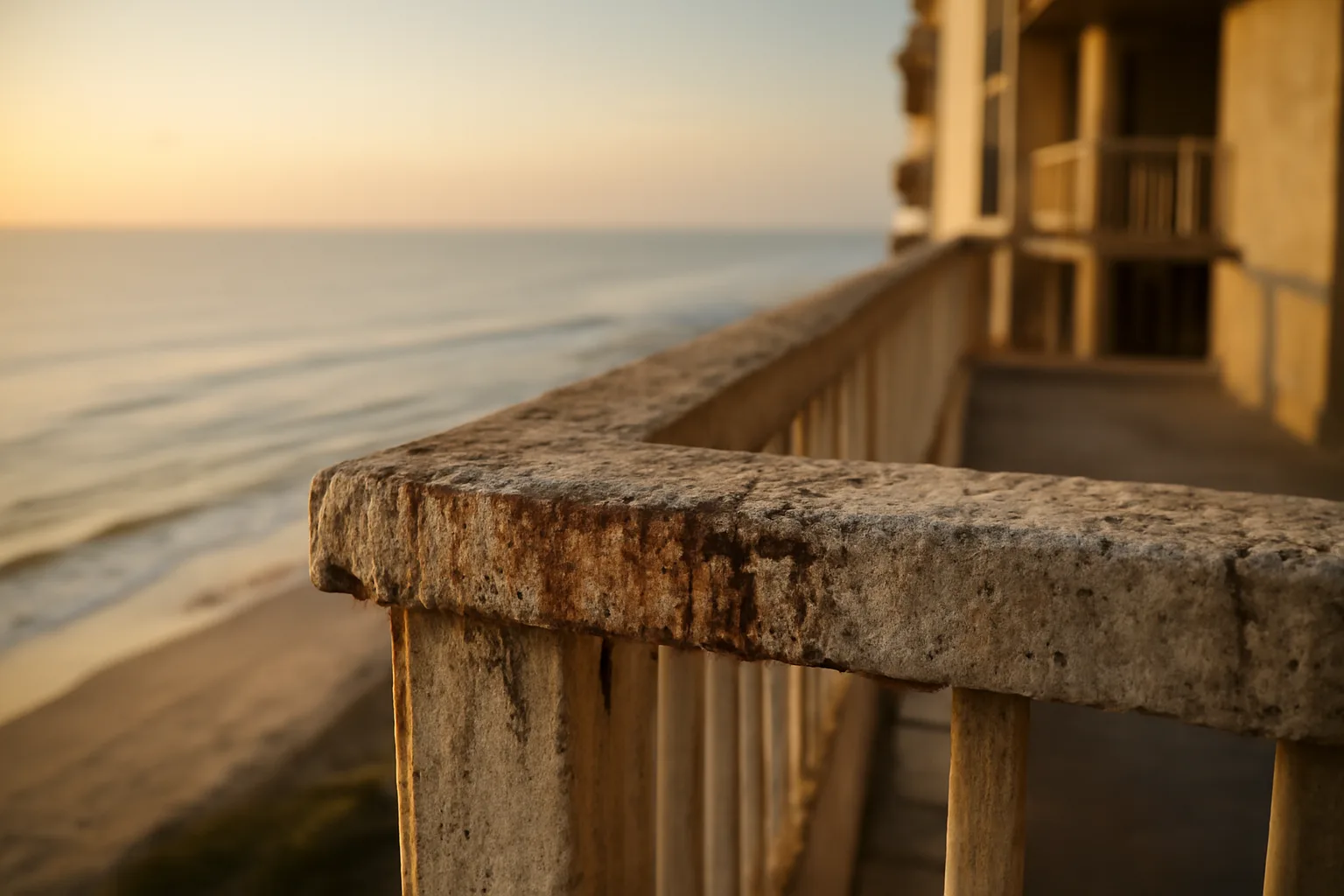
Hollywood sits directly on the Atlantic in Broward County, and buildings within roughly a mile of saltwater generally see faster degradation of exposed rebar, balcony railings, and exterior waterproofing than inland buildings of the same age. Salt-laden air accelerates corrosion of embedded steel, which is exactly the kind of concrete spalling issue that drove the Champlain Towers South investigation . What this means practically: a Hollywood beachfront building's SIRS-recommended remaining useful life estimates for concrete and waterproofing components may run shorter than a similar-aged building in, say, inland Broward or Orlando. Boards near A1A should expect their engineer to flag more near-term structural line items, and should budget assuming inspection intervals for follow-up monitoring may need to be tighter than the statutory 10-year SIRS cycle suggests. If your building is inland along Hollywood Boulevard or near I-95, don't assume you're off the hook; you still owe the same SIRS and milestone inspection under state law, just possibly with a longer runway on component life before major work is needed. Confirm your building's actual exposure and age-related risk with your licensed engineer, not with a general rule about distance from the ocean.
How does a milestone inspection relate to SIRS?
Milestone inspections and SIRS are two separate but overlapping requirements under Florida law. Milestone inspections, under Fla. Stat. 553.899, are physical structural inspections of buildings 3 stories or more, due at 30 years from certificate of occupancy (or 25 years if within 3 miles of the coast, which covers essentially all of Hollywood), and every 10 years after . SIRS is the reserve-funding study; milestone inspection is the structural safety check. They can use overlapping engineering data, and many Florida engineers coordinate the two visits, but they serve different statutory purposes and go to different regulators in different formats. A building can be current on one and behind on the other. Because Hollywood is within 3 miles of the coast essentially citywide, the 25-year milestone trigger applies broadly here rather than the 30-year standard trigger. Check your building's certificate of occupancy date against the county's specific mile-marker determination, since "3 miles of the coastline" is defined by statute referencing the Florida Coastal Mapping Program, more than a rough guess . For the fuller mechanics, see our milestone inspections coverage.
How does a board actually organize all this paperwork?
This is the unglamorous part that trips up more boards than the engineering itself. A SIRS report, a milestone inspection report, updated reserve schedules, DBPR filings, and owner notices all have different deadlines, different required recipients, and different formats. Miss one filing window and you're explaining yourself to angry owners or a regulator, neither of which is fun on a volunteer board's time budget. Some boards hire a management company to track all of it; many self-managed Hollywood associations just use spreadsheets and hope nothing falls through. If you want a structured, building-specific way to organize the SIRS report, milestone inspection dates, reserve funding schedule, and owner communication templates without hiring a full-time compliance consultant, our $199 one-time Building-Specific Board Compliance Kit is built for exactly this: it organizes what the licensed engineers and reserve specialists produce, and schedules the deadlines around it. It doesn't replace your engineer's inspection or your CPA's tax advice, and it can't tell you whether specific items in your building meet code. Those calls belong to licensed professionals and your association's counsel. Whatever tool or process you use, the core discipline is the same: know your building's certificate of occupancy date, know your milestone trigger year, know your SIRS completion date, and calendar the next cycle now, not the year it's due.
Where can Hollywood boards verify requirements directly?
Don't take any single article's word for your building's specific obligations, including this one. Fla. Stat. 718.112 is the primary source for SIRS and reserve funding rules and is available in full text at flsenate.gov [1]. Fla. Stat. 553.899 covers milestone inspections . DBPR's Division of Florida Condominiums, Timeshares, and Mobile Homes publishes guidance and forms related to condo association filings at myfloridalicense.com [3]. For Hollywood-specific building recertification rules layered on top of state law, contact the City of Hollywood Building Division directly, since local recertification timelines and documentation requirements can differ from the state minimums and change independent of Tallahassee. Statutes get amended almost every legislative session, and SIRS in particular has already seen adjustments since its 2022 creation (including relief provisions discussed in our florida condo reserve fund relief piece). Always confirm current requirements with your association's counsel and your county building department before finalizing budgets or owner communications.
Frequently asked questions
What is a reserve study?
A reserve study is a professional assessment of a building's shared components (roofs, plumbing, structural elements, amenities) that estimates each item's remaining life and replacement cost, then converts that into a recommended annual reserve contribution. Florida's SIRS is a narrower, statutorily mandated version covering only structural and life-safety items for condo buildings 3+ stories.
What is a reserve study for an HOA?
For a homeowners association, a reserve study is a voluntary or documents-driven financial planning tool covering shared assets like roads, clubhouses, and pools. It's different from a condo SIRS, which is a Florida statutory mandate under Fla. Stat. 718.112 applying only to condominium associations with buildings 3 stories or taller.
What is an HOA assessment?
An HOA assessment is a fee owners pay to the association, either regular (monthly or annual dues covering operating costs and reserves) or special (a one-time or installment charge for a specific unfunded expense, like a roof replacement or storm repair not covered by reserves).
How much should an HOA have in reserves?
There's no universal dollar figure; it depends on your specific components and their replacement costs. For Florida condo SIRS-covered structural items, the legal minimum since the 2025 budget year is 100% of the study's calculated funding requirement, with no owner vote allowed to waive or reduce it, per Fla. Stat. 718.112.
How much does a reserve study cost?
A standard non-structural reserve study typically runs $500 to $6,000 depending on community size. A Florida SIRS, which requires a licensed engineer or architect, tends to cost more, with reported figures ranging from roughly $75 per unit on large buildings up to $20,000-$30,000+ total for complex high-rises, per Florida engineering industry reporting.
Are HOA special assessments tax deductible?
Generally no, for a personal residence. Special assessments for capital improvements typically add to your cost basis rather than being currently deductible, similar to regular dues. Rental property owners may have partial deductibility depending on use; consult a CPA, since IRS rules on capital improvements versus repairs are fact-specific.
When was the Florida SIRS deadline?
The statewide deadline for a condo association's first structural integrity reserve study was December 31, 2024, for buildings 3 stories or higher, per Fla. Stat. 718.112(2)(g). Full funding of SIRS-covered reserve items became mandatory starting with the first budget adopted on or after that date.
Does Hollywood, FL have its own recertification rules beyond the state SIRS law?
Broward County, where Hollywood is located, has required building recertification (originally 40-year, then every 10 years) since long before the state's 2022 SIRS and milestone laws. Hollywood boards should confirm with the city's building division whether local recertification timelines run separately from state SIRS and milestone deadlines.
What's the difference between a milestone inspection and a SIRS?
A milestone inspection (Fla. Stat. 553.899) is a structural safety check due at 25 years (if within 3 miles of the coast) or 30 years from certificate of occupancy, then every 10 years. A SIRS is the reserve-funding study feeding into the budget. They can overlap in engineering work but are legally separate requirements.
Can a Hollywood condo board vote to waive SIRS reserve funding?
No. Under Fla. Stat. 718.112(2)(f)(3), owners can no longer vote to waive or reduce reserves for SIRS-covered structural components once the study is completed, starting with budgets adopted on or after December 31, 2024. Non-SIRS items (paint, landscaping) can still be waived or reduced by owner vote.
Who is qualified to perform a SIRS in Florida?
A SIRS must be performed by a licensed engineer or architect, per Fla. Stat. 718.112(2)(g). Boards should verify the professional's Florida license through DBPR before hiring, and get multiple quotes since pricing varies significantly by building size, height, and structural complexity.
What happens if a Hollywood condo association missed its SIRS deadline?
The statewide deadline of December 31, 2024 has passed. If your association hasn't completed a SIRS, the priority is scheduling one immediately with a licensed engineer, documenting the delay for owners, and confirming next steps with the association's counsel, since late compliance can carry regulatory and liability exposure with DBPR.
Sources
- Florida Senate, Florida Statutes Chapter 718.112: SIRS requirement, components covered, funding mandate, and December 31, 2024 deadline
- Florida Senate, Florida Statutes Chapter 719.106: Parallel structural reserve study requirement for cooperative associations
- Florida DBPR, Division of Florida Condominiums, Timeshares, and Mobile Homes: State regulator overseeing condo association filings and SIRS-related guidance
- Florida Senate Staff Analysis, SB 154 (2023): Legislative analysis discussing SIRS cost impacts and implementation on Florida condo associations
- Fannie Mae, Selling Guide reserve fund guidance: Industry benchmark that reserve funds below roughly 30-70% funded levels carry higher special assessment risk
- Florida Senate Staff Analysis, SB 4-D (2022): Post-Surfside legislative context for SIRS and milestone inspection requirements and cost impact discussion
- IRS, Publication 527, Residential Rental Property: Tax treatment of capital improvements versus repairs for rental property, relevant to special assessment deductibility
- Florida Senate, Florida Statutes Chapter 553.899: Milestone inspection requirement, 25-year coastal trigger and 30-year standard trigger, and 10-year recurrence