Last updated 2026-07-24
TL;DR
A structural inspection for condos in Florida means two separate things: the milestone inspection (a licensed engineer's physical exam of the building at 30 years, or 25 years within 3 miles of the coast) and the SIRS (a reserve study covering specific structural components). Both are required under Florida Statutes ch. 718 for buildings 3 stories and up.
What is a structural inspection for a condo building in Florida?
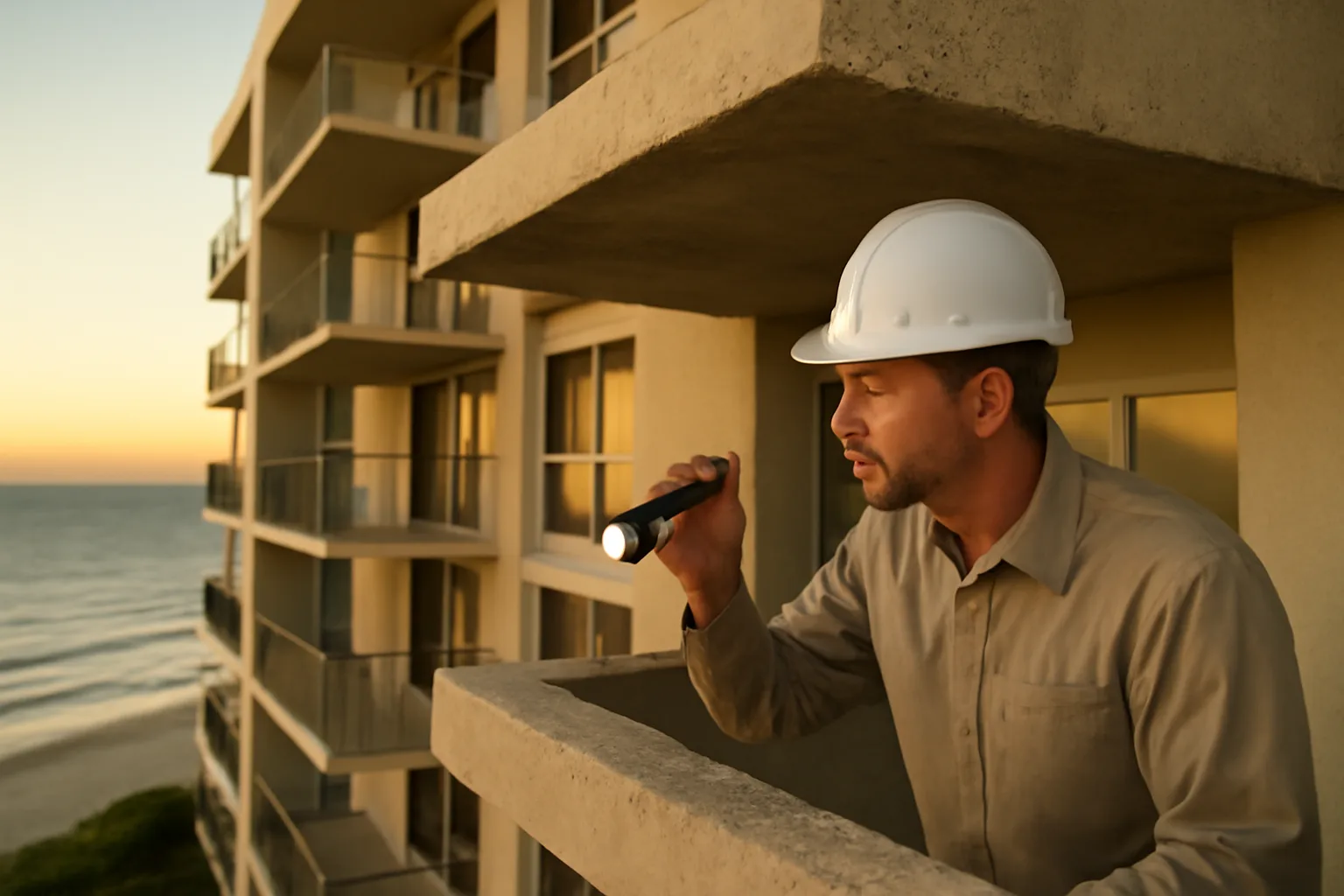
A structural inspection for a condo, in the way most people mean it now, is the milestone inspection required under Florida Statutes section 553.899 [1]. It's a physical, hands-on assessment of a building's structural integrity, done by a licensed architect or engineer, triggered by the building's age and, in coastal areas, its distance from the water. The law came out of the 2021 Champlain Towers South collapse in Surfside, which killed 98 people. Florida lawmakers passed SB 4-D in 2022, then refined it with SB 154 in 2023, creating the current statewide framework [1]. Before that, milestone-style inspection rules existed only in a handful of counties, mainly Miami-Dade and Broward. The statute applies to buildings that are 3 stories or more in height and contain at least one condominium, cooperative, or, in some cases, other habitable structures. Single-family homes and duplexes are exempt. Parking garages attached to qualifying buildings can fall under the requirement too, depending on how the local building official interprets the structure. Separately, and often confused with the milestone inspection, is the Structural Integrity Reserve Study (SIRS). This isn't a hands-on engineering inspection in the same sense. It's a reserve funding study that has to address specific structural components (roof, load-bearing walls, foundation, and more) so the association can set aside real money instead of underfunding reserves. Boards need both. They serve different purposes and have different triggers, timelines, and professionals attached to them.
When is a milestone inspection required, and does age or coastal proximity matter?
A milestone inspection is required when a building reaches 30 years old, based on its certificate of occupancy date, and then every 10 years after that [1]. If the building sits within 3 miles of the coastline, the first inspection moves up to 25 years old, with recertification every 10 years after. How "3 miles of the coastline" gets measured is a local building department call, not something a board decides on its own. Some counties draw the line differently than you'd expect from looking at a map, so confirm the distance and the applicable deadline with your county building department, not a guess based on GPS coordinates. For buildings that got their certificate of occupancy before July 1, 1992, the statute set a transition schedule: local enforcement agencies had to notify these older buildings of their inspection deadlines by December 31, 2024, generally requiring the milestone inspection be completed by December 31, 2024, or on a schedule set by the local authority based on the building's age [1] [2]. If your building is old enough that this already should have happened and you're not sure it did, that's a call to your property manager and county building official this week, not next quarter. The milestone inspection happens in two phases. Phase 1 is a visual examination, no destructive testing, done by the licensed engineer or architect. If Phase 1 turns up "substantial structural deterioration," the professional moves to Phase 2, which can include more invasive testing (core samples, moisture readings, whatever the engineer needs to determine the extent of the problem) [1].
What is a SIRS (Structural Integrity Reserve Study) and how is it different from a reserve study?
A SIRS is a specific kind of reserve study required under Florida Statutes section 718.112, and it's narrower than a general reserve study in what it must cover, but it isn't optional the way old-style reserve waivers used to be. A reserve study in the general sense looks at everything the association is responsible for maintaining: roofs, paint, pavement, pool equipment, elevators, whatever's in the governing documents. A SIRS focuses on specific structural and life-safety components: roof, structure (load-bearing walls and other primary structural members), fireproofing and fire protection systems, plumbing, electrical, waterproofing and exterior painting, windows and doors, and any other item with a deferred maintenance expense or replacement cost over $10,000 that, if left unaddressed, threatens the safety of building occupants. Buildings 3 stories or higher (again, the same height threshold as milestone inspections) had to have their first SIRS completed by December 31, 2024 [3]. After that, it's every 10 years. The SIRS has to be based on a visual inspection performed by a licensed engineer, architect, or a reserve specialist qualified under the statute's terms. Here's the part that trips up boards: once you have a SIRS, the statute no longer lets you vote to waive or reduce reserve funding for the components it covers. Owners can still vote to reduce or waive reserves for non-SIRS items (like painting the clubhouse or replacing pool furniture), but not for roof, structure, and the other SIRS-mandated categories. That's a real change from the old rules, where a simple majority vote at the annual meeting could gut reserve funding almost entirely.
What is a reserve study for an HOA, and does it work the same way?
A reserve study for an HOA is a financial planning document, usually prepared by a reserve specialist, that estimates the remaining useful life of major common-area components and calculates how much money the association needs to be saving each year to replace them without a special assessment. HOAs (homeowners associations governing single-family homes or townhomes, as opposed to condominiums) are NOT currently subject to the milestone inspection or SIRS requirements under Chapter 718, because those statutes apply specifically to condominiums and cooperatives [1]. If your community is a true HOA with no condominium units, the structural inspection mandate doesn't apply to you directly, though your governing documents or insurer might still require periodic inspections. Florida's separate HOA statute, Chapter 720, does not currently impose the same mandatory structural reserve study requirement that Chapter 718 does for condos. HOA boards should confirm this distinction with counsel, because there's been ongoing legislative discussion about extending similar requirements, and the rules could change [4]. A general reserve study is still smart practice for any HOA managing roofs, roads, or amenities, whether or not the law forces it.
What is an HOA assessment and how is it different from a special assessment?
An assessment, in HOA or condo terms, is money the association charges owners to cover its budget. Regular assessments are the routine dues, usually monthly or quarterly, that fund operating expenses and reserve contributions. A special assessment is a one-time (or occasionally installment-based) charge outside the regular budget, usually because something unexpected came up or reserves fell short of an actual repair cost. What are HOA assessments used for, specifically? Regular assessments cover landscaping, insurance, management fees, utilities for common areas, and reserve contributions. Special assessments typically cover large capital repairs: a roof replacement that reserves didn't fully fund, storm damage not covered by insurance, or in condo buildings specifically, the cost of Phase 2 milestone inspection work or SIRS-driven structural repairs. Florida Statutes section 718.116 governs how condo assessments get levied and collected, including the association's lien rights if an owner doesn't pay. For HOAs, Chapter 720 has its own assessment and lien provisions. Neither statute puts a hard dollar cap on how large a special assessment can be. The board's authority comes from the declaration and bylaws, and boards should get counsel's read on notice requirements before levying anything large. This is exactly where a milestone inspection or SIRS finding tends to land on an owner's mailing list: the building needed $2 million in concrete restoration, reserves had $400,000, and the special assessment covers the gap.
How much should an HOA or condo have in reserves?
There's no single dollar figure the law requires. Florida's SIRS statute requires "full funding" based on the components the study identifies, meaning reserves are supposed to track the actual, professionally estimated useful life and replacement cost of each component, not an arbitrary percentage. That said, industry reserve specialists commonly talk about a "percent funded" benchmark: the ratio of what an association actually has in reserves versus what it theoretically should have if fully funded on a straight-line basis. A commonly cited healthy target from reserve study professionals is 70% funded or higher, with anything under 30% considered "weak" or at high risk of special assessments. These aren't Florida statutory numbers, they're industry rules of thumb from organizations like the Community Associations Institute (CAI), so treat them as a gut check, not a legal floor. How much should an HOA have in reserves in raw dollars depends entirely on the building: age, number of units, roof type, climate exposure, elevator count. A 12-unit garden-style HOA with a 15-year-old roof needs a completely different reserve balance than a 200-unit oceanfront condo tower with two elevators and a seawall. This is exactly why the statute requires a professional study rather than a formula. A DIY guess, even a well-intentioned one from a finance-savvy board member, isn't going to hold up against actual replacement costs when the roof needs to come off in year 18.
How much does a reserve study cost?
Reserve study costs in Florida commonly run from roughly $3,000 to $15,000 or more, depending on building size, number of components tracked, and whether it's a full SIRS-compliant study or a basic reserve study for a small HOA [5]. A small HOA with a handful of components might pay toward the low end. A high-rise condo tower with elevators, a seawall, multiple roof sections, and full SIRS component coverage will land toward the higher end, sometimes above it for very large or complex properties. Milestone inspections are a separate cost and get billed separately from the SIRS. Phase 1 milestone inspections often run several thousand dollars for a mid-size building, but costs scale hard with building size, height, and complexity, and Phase 2 (if triggered) adds significant cost for engineering analysis, testing, and reporting. There isn't a reliable statewide average because DBPR doesn't publish inspection or study cost data, and pricing varies by firm, region, and building type. Get at least two or three quotes from licensed firms rather than accepting the first bid, and ask specifically whether the quote includes SIRS component-level detail or just a general reserve estimate. One-time studies aren't a "set it and forget it" expense either. SIRS updates are required every 10 years, and boards that want a mid-cycle sanity check (especially after major repairs or a special assessment) sometimes commission an update sooner. Budget for it as a recurring line item, not a surprise.
Are HOA special assessments tax deductible?
For most owners, no. Special assessments for capital improvements (a new roof, structural repairs, a new elevator) are generally not tax deductible as an ongoing expense. Instead, the IRS treats them as an addition to your cost basis in the property, which can reduce capital gains tax when you eventually sell. There are narrow exceptions. If you rent out the unit, a special assessment tied to a repair (as opposed to a capital improvement) may be deductible as a rental expense in the year paid, subject to IRS depreciation and repair-versus-improvement rules. If part of your home is used for business, a portion might be deductible under home office rules. None of this is a substitute for advice from a CPA who's looked at your specific situation, and the repair-versus-capital-improvement distinction is exactly the kind of thing the IRS scrutinizes closely. This is worth flagging early to your ownership, because a $15,000 special assessment notice lands very differently on someone who assumes it's a tax write-off versus someone who understands it's a basis adjustment they'll only benefit from years later at sale. Boards aren't required to give tax advice and shouldn't try, but pointing owners toward a qualified tax preparer in the assessment notice is a reasonable, low-risk thing to do.
Who is licensed to perform a milestone inspection or a SIRS in Florida?
Milestone inspections must be performed by a licensed architect or engineer, and that professional has to be authorized to practice in Florida [1]. You can verify a license through the Florida Department of Business and Professional Regulation (DBPR) online license search. Don't rely on a contractor's word that they're "basically an engineer" or that they've "done this before." Check the license. For a SIRS, the statute allows the study to be prepared by a licensed engineer or architect, or by a reserve specialist as recognized by the Community Associations Institute, provided the visual inspection portion is performed or directly supervised by a licensed engineer or architect. Reserve study firms often employ credentialed reserve specialists (RS designation through CAI) working alongside a licensed engineer for the structural sign-off. Boards sometimes ask whether the same firm can do both the milestone inspection and the SIRS. There's no statutory prohibition on that, and some firms market a combined engagement, but nothing in the law requires it either. Get separate proposals and compare. A firm that does great work on Phase 1 milestone inspections isn't automatically the best fit for reserve funding analysis, and vice versa.
What happens if a board skips or delays the milestone inspection or SIRS?
Skipping a required milestone inspection or SIRS isn't a paperwork violation you can quietly fix later. Local building officials can issue notices of noncompliance, and in some jurisdictions can restrict occupancy or certificate renewal until the building complies [1] [2]. Boards also carry fiduciary exposure: directors who ignore a statutory safety requirement are exposed to claims from owners if something goes wrong, and that exposure doesn't disappear just because the association is small or the building looks fine. There's also a practical, non-legal reason to stay current: lenders and insurers increasingly ask for milestone inspection and SIRS status before writing new mortgages or renewing coverage on condo units. Fannie Mae and Freddie Mac both tightened condo project eligibility requirements after Surfside, specifically asking about structural inspections, deferred maintenance, and reserve funding status on lender questionnaires. A building that's behind on its milestone inspection can end up with buyers who can't get financing, which tanks resale values association-wide, more than for the owner trying to sell. If your association is behind schedule, the fix is not to panic-hire the cheapest engineer available. Call your county building department, explain where you are, and get a realistic timeline in writing. Most local building officials would rather work with a board that's communicating than discover a building went silent for two years.
How do boards pay for the repairs a milestone inspection or SIRS uncovers?
Once a Phase 1 or Phase 2 milestone report, or a SIRS, identifies real dollar figures for structural work, the board generally has three funding paths: existing reserves, a special assessment, or a loan, often used in combination. If reserves cover it, great, that's the whole point of proper SIRS funding. Most buildings transitioning into full SIRS compliance right now don't have decades of full funding behind them, though, so a gap between what's needed and what's saved is common. That's when boards turn to a special assessment or explore special assessment insurance products that some associations are now buying to spread large repair costs over time rather than hitting owners with a lump sum. Association loans, sometimes called community association loans, are another option: a bank or credit union lends the association money for the repair, and the loan gets repaid through an installment special assessment over several years instead of one large bill. This can ease the cash-flow hit on individual owners, particularly retirees on fixed incomes, but it adds interest cost and requires board diligence on loan terms. None of these choices are risk-free, and none are one-size-fits-all. A board facing a seven-figure structural bill should get input from a CPA or association attorney before committing to a specific funding mix, more than from the engineer who found the problem.
How can a board actually stay organized through all of this?
The paperwork burden here is real: milestone inspection reports, SIRS documents, engineer contracts, special assessment notices, insurance renewal questionnaires, county correspondence, all with different deadlines and different recipients (owners, lenders, county officials, insurers). Missing one piece, or sending the wrong version to a mortgage underwriter, causes real delays for owners trying to sell or refinance. This is the specific gap the Board Compliance Kit at BoardDeadline is built for: a $199 one-time kit that organizes your building's actual milestone and SIRS deadlines by age, height, and coastal proximity, and helps schedule and communicate the required steps to owners, lenders, and county officials. It doesn't replace your engineer, your reserve specialist, or your attorney, and it doesn't perform inspections or make compliance determinations. Those calls belong to the licensed professionals the statute requires and to your association's own counsel, who knows your governing documents and your county's specific enforcement posture. Whatever tool or system a board uses, the core discipline is the same: know your building's exact CO date, know your county's coastal-mileage rule, calendar both the milestone and SIRS 10-year cycles separately, and keep every report in one place that survives board turnover. Boards change every year or two. The building's age doesn't reset.
Frequently asked questions
What is a reserve study?
A reserve study is a professional assessment of a building's major common-area components (roofs, elevators, structure, pavement) that estimates remaining useful life and replacement cost, then calculates how much an association should save each year. In Florida condos, a SIRS is the statutorily required version covering specific structural components under Florida Statutes section 718.112 [4].
What is a reserve study for an HOA?
For an HOA, a reserve study is a financial planning tool, not currently a Chapter 718 legal mandate the way it is for condos. It still estimates component life and replacement costs so the board can budget properly instead of relying on emergency special assessments when something big fails.
What is an HOA assessment?
An HOA assessment is money the association charges owners, either as regular recurring dues that fund operations and reserves, or as a special assessment, a one-time or installment charge for costs the regular budget and reserves didn't cover, like an uninsured repair or a major capital project.
How much should an HOA have in reserves?
There's no fixed statutory dollar figure. Florida's SIRS law requires full funding based on actual component costs identified by a licensed professional [4]. Industry benchmarks from reserve specialists often cite 70% funded or higher as healthy, and under 30% as high risk, but these are guidelines, not law [8].
How much does a reserve study cost?
Reserve studies in Florida commonly cost $3,000 to $15,000 or more, depending on building size and complexity [9]. Small HOAs with few components land toward the low end; large SIRS-compliant condo towers with elevators, seawalls, and multiple structural systems cost more. Get multiple quotes from licensed firms.
Are HOA special assessments tax deductible?
Generally no. Special assessments for capital improvements typically add to your cost basis rather than count as a deductible expense, which can reduce capital gains tax when you sell [10]. Rental property owners may deduct repair-related assessments differently. Talk to a CPA about your specific situation.
What triggers a milestone inspection in Florida?
A building reaching 30 years old, based on its certificate of occupancy date, triggers the first milestone inspection, or 25 years old if the building is within 3 miles of the coastline [1]. Recertification happens every 10 years after that. Buildings 3 stories or taller are covered.
What is the difference between a milestone inspection and a SIRS?
A milestone inspection is a physical, hands-on structural exam by a licensed engineer or architect, done at age 30 (or 25 near the coast) and every 10 years after [1]. A SIRS is a reserve funding study covering specific structural components, first due by December 31, 2024, then every 10 years [4]. Both are required; they're not interchangeable.
Do single-family HOAs need a milestone inspection?
No. Milestone inspections and SIRS requirements under Florida Statutes ch. 718 apply to condominiums and cooperatives, buildings 3 stories or more. True HOAs governing single-family homes are not currently subject to these specific statutes, though this could change with future legislation. Confirm with counsel.
What happens if my condo building fails a Phase 1 milestone inspection?
A Phase 1 finding of substantial structural deterioration triggers a Phase 2 inspection, which can include destructive testing like core samples. The engineer then determines the scope and urgency of needed repairs, and the association must act on those findings, often requiring a special assessment or loan to fund the work.
Who pays for milestone inspections and SIRS studies?
The association pays, typically funded through regular assessments or reserves, since these are association-required professional services, not individual owner obligations. If reserves are insufficient, boards may need a special assessment to cover the inspection and study fees themselves, on top of any repair costs the reports identify.
Can a condo association still waive reserve funding after a SIRS is done?
No, not for SIRS-covered components. Once an association has a completed SIRS, owners cannot vote to waive or reduce reserve funding for the specific structural items it covers (roof, load-bearing structure, and similar) [4]. Reserves for non-SIRS items can still be waived or reduced by owner vote.
Sources
- Florida Statutes, Section 553.899, Milestone Inspection: Milestone inspection age and coastal-proximity triggers, Phase 1 and Phase 2 process
- Florida Statutes, Section 718.112, Structural Integrity Reserve Study requirements: SIRS component list, funding restrictions, and licensing requirements for preparers
- Florida Statutes, Chapter 720, Homeowners' Associations: HOA governing statute lacks the same mandatory SIRS requirement as Chapter 718 condos
- Florida Statutes, Section 718.116, Assessments; liability; lien and priority: Legal basis for condo assessment levying and lien rights
- Internal Revenue Service, Publication 523, Selling Your Home: Capital improvement assessments generally add to cost basis rather than being currently deductible