Last updated 2026-07-25
TL;DR
A Florida milestone inspection must be performed by a licensed architect or engineer authorized to practice in Florida, per Fla. Stat. § 553.899. Phase 1 typically costs $5,000-$15,000+ depending on building size; if repairs are flagged, Phase 2 and the repairs themselves can run into six or seven figures. Boards should start hiring 12-18 months before their deadline.
Who is legally allowed to perform a Florida milestone inspection?
Only a licensed architect or engineer authorized to practice in Florida can perform and certify a milestone inspection. Florida Statute § 553.899 says the inspection "must be performed by a licensed architect or engineer authorized to practice in this state" [1]. That means a Florida license number, in good standing, issued by the state's Board of Architecture and Interior Design or Board of Professional Engineers, both under DBPR oversight. This isn't a general contractor's job, and it isn't something a property manager can sign off on. The statute requires the inspector to physically observe the building's structural components and issue a written, sealed report. Boards sometimes get pitched by firms that subcontract the actual site visit to a junior staffer while a senior engineer signs remotely. Ask directly who will be on-site and whose seal goes on the report. You want the sealing engineer to have actually walked the building, or at minimum to have directly supervised whoever did. For buildings within three miles of the coast, the statute layers on an additional requirement: a more detailed Phase 1 inspection scope tied to Fla. Stat. § 553.899(2), because of accelerated corrosion risk. Confirm with your association's counsel and county building department which threshold distance rule applies to your specific parcel, since "three miles from a coastline" is measured a specific way and local building departments sometimes have their own interpretation guidance.
What does a milestone inspection actually check, and how is it different from a SIRS?
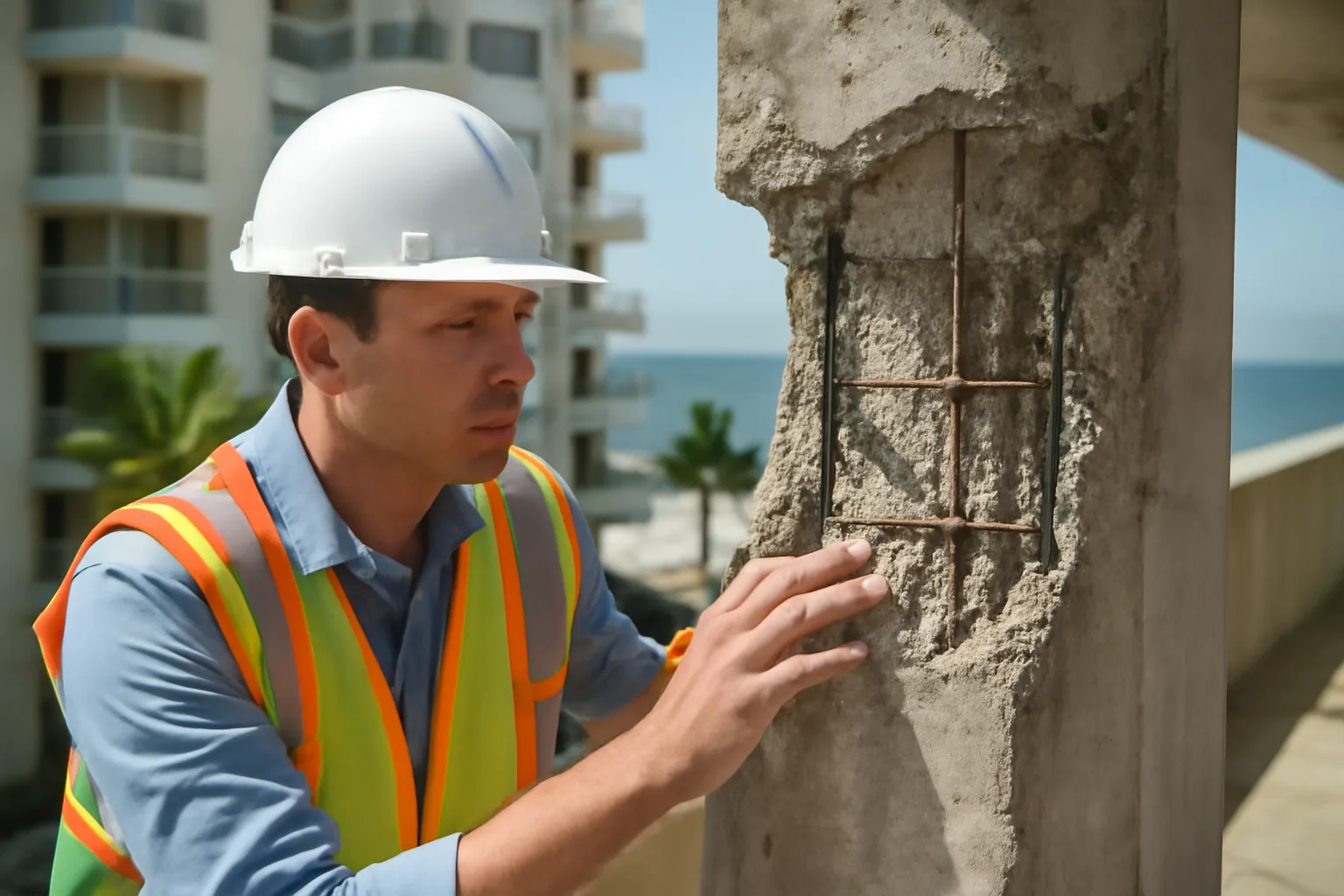
A milestone inspection is a structural safety check performed by an engineer; a SIRS (Structural Integrity Reserve Study) is a funding and lifecycle-planning document that can be done by an engineer, but also by other qualified professionals for some components. They serve different legal purposes even though many boards commission them close together. The milestone inspection under § 553.899 has two phases. Phase 1 is a visual survey of the load-bearing structure: columns, beams, roof structure, and other primary structural elements, looking for signs of substantial structural deterioration. If Phase 1 finds no distress, that's often the end of it for that cycle. If the engineer finds signs of "substantial structural deterioration," the law requires a Phase 2 inspection, which can involve destructive or invasive testing (core samples, exposing rebar, etc.) [1]. The SIRS, created by Fla. Stat. § 718.112(2)(g), is a study of the useful life and remaining useful life of specific structural components (roof, load-bearing walls, floor, foundation, fireproofing, electrical wiring, plumbing, waterproofing, and others listed in the statute) and the reserve funding needed to maintain them [2]. A reserve study for condo association boards commission covers this ground in more depth. Some firms offer bundled milestone-plus-SIRS engagements, which can save on mobilization costs since the engineer is already on-site measuring the same structural elements twice.
How much does a milestone inspection cost in Florida?
Phase 1 milestone inspections commonly run $5,000 to $15,000+ for mid-size condo buildings, though DBPR does not publish a fixed fee schedule since pricing is set by the private engineering market, not the state. Cost depends heavily on square footage, number of stories, number of structural systems, and how easy the building is to access (parking garages and seawalls add complexity). High-rises and buildings with complicated structural systems (post-tensioned concrete, for example, which needs specialized non-destructive testing) push costs higher, sometimes $20,000-$40,000 for Phase 1 alone. If Phase 2 gets triggered, costs jump again: destructive testing, lab analysis of concrete cores, and follow-up reports can add tens of thousands more. And if Phase 2 finds actual structural deterioration requiring repair, you're now talking construction costs, which is a different order of magnitude entirely, often six figures and up depending on scope. Get at least three quotes. Ask each firm to itemize Phase 1 versus contingent Phase 2 pricing so you're comparing like to like, and ask what their day rate is if Phase 2 becomes necessary versus a fixed follow-on fee.
When is a milestone inspection due for my building?
Buildings three stories or higher generally need their first milestone inspection by December 31 of the year they turn 30 years old, based on the certificate of occupancy date, per Fla. Stat. § 553.899(3)(a) [1]. Buildings within three miles of the coastline face an earlier trigger: 25 years old, under § 553.899(3)(b) [1]. After the first inspection, recertification is required every 10 years. A 2023 statutory amendment (SB 154) also created a rule for buildings that had already passed the 30-year mark as of July 1, 2022: those buildings had until December 31, 2024 to complete their milestone inspection, regardless of original CO date, unless local authorities extended that deadline [3]. Many counties, including Miami-Dade and Broward, which had their own pre-existing recertification programs, layered additional local requirements on top of the state law, so check with your county building department directly, more than the state statute. Missing the deadline isn't a paperwork technicality. Local building officials can require the association to submit a plan for compliance, and in the worst cases can pursue unsafe structure proceedings against the building. Boards that are already late should call their county building official proactively rather than waiting for a notice.
What is a reserve study, and is it the same thing as a SIRS?
A reserve study is a professional assessment of a building's major components (roof, paving, painting, plumbing, structural elements, and more), their remaining useful life, and how much money the association needs to set aside each year to replace them without a surprise special assessment. A SIRS is Florida's statutory version of this for condo and cooperative associations, with a specific required component list under § 718.112(2)(g) [2]. General reserve studies (the kind HOAs across the country use, more than Florida) usually come in two flavors: a full study with an on-site visual inspection, and an update study that revisits the numbers without a new site visit. The national reserve study standard, maintained by the Community Associations Institute (CAI), recommends a full study with a site visit at least every 3-5 years, updated annually with a desktop review [4]. For Florida condos, the SIRS is not optional and more than "recommended." Fla. Stat. § 718.112(2)(g) requires it for buildings three stories or higher, tied to the same milestone inspection age triggers [2]. A hoa reserve study for a non-condo HOA in Florida doesn't currently carry the same statutory mandate, though many mortgage lenders and insurers now expect one anyway.
What is a reserve study for an HOA, specifically?
For a homeowners association (as opposed to a condo association), a reserve study estimates the remaining life and replacement cost of shared common-area assets: roads, pool decks, clubhouse roofs, retention ponds, gates, and similar items the HOA is legally responsible to maintain. It's the financial planning twin of a milestone inspection's structural safety focus. Unlike condo SIRS studies, Florida law does not currently mandate reserve studies for most single-family HOAs the way it does for condos under § 718.112. HOAs are governed mainly by Fla. Stat. ch. 720, which has its own reserve funding provisions but with more flexibility for boards to waive or reduce reserve contributions by membership vote in many circumstances. Confirm with your association's counsel exactly what your declaration and ch. 720 require, since HOA reserve rules have been amended repeatedly and vary by whether reserves were established in the original declaration. Even where not legally required, a reserve study is cheap insurance against a bad surprise. Boards that skip it tend to fund reserves based on "what we've always budgeted," which almost never matches actual replacement costs once you price out a new roof or repaving a mile of private road at current material costs.
How much does a reserve study cost?
Reserve studies for condo or HOA associations typically run $3,000 to $8,000 for a full study with a site visit, and $1,000 to $3,000 for an update study without one, though pricing varies by state, building size, and number of components studied. There's no single national or Florida-specific fee schedule; CAI's own guidance describes cost as driven by property size, number of components, and complexity rather than a fixed rate [4]. A full SIRS for a Florida condo building tends to run somewhat higher than a generic reserve study because of the statutory component list and structural detail required under § 718.112(2)(g), sometimes $5,000-$15,000+ depending on building size and whether it's bundled with the milestone inspection engineer's site visit. Compare that cost to what happens without one: an association that underfunds reserves for a decade and then faces a roof replacement or concrete restoration project can be looking at a special assessment of tens of thousands of dollars per unit. The study itself is a small line item next to that risk.
How much should an HOA or condo association have in reserves?
There's no single dollar figure that applies to every building; it depends on the building's age, size, and the remaining life of each major component. The right benchmark isn't a flat number, it's whether your reserve fund is "fully funded" relative to what your reserve study says you'll need, measured as a percent-funded ratio (reserves on hand divided by the ideal reserve balance for where each component is in its life cycle). CAI and reserve-study professionals generally consider 70% funded or higher a healthy range, with anything under 30% considered high risk for a special assessment [4]. Florida's SIRS statute takes a stricter approach for the components it covers: as of the relevant funding deadlines, condo associations are required to fund those specific SIRS reserve components at the full amount recommended by the study, without the option to waive or underfund them by membership vote, per § 718.112(2)(f) [2]. That's a meaningful departure from the old rule, where owners could vote annually to reduce or waive reserve funding. Boards should ask their reserve study preparer for the percent-funded number directly, more than the total dollar balance. A building sitting on $2 million in reserves can still be badly underfunded if the study says it needs $5 million given the age of its roof, elevators, and plumbing. For background on how the funding mandate phased in and what relief options exist, see florida condo reserve fund relief.
What is an HOA assessment, and how is it different from a special assessment?
An HOA assessment is simply the money an association charges its members to cover shared expenses. Regular (or "annual") assessments fund the operating budget and reserves every year. A special assessment is a one-time, extra charge levied when regular assessments and reserves aren't enough to cover an unexpected or large expense, like storm damage, a failed roof, or milestone/SIRS-triggered structural repairs. Boards typically need a specific vote or authority under the governing documents to levy a special assessment, and the amount is usually tied directly to a defined project or shortfall rather than ongoing operations. See hoa special assessment for how the approval process generally works and what disclosures are typically owed to owners before a vote. Associations that keep reserves properly funded (the whole point of a reserve study or SIRS) are the ones that avoid large special assessments. It's not a coincidence that Florida's post-Surfside legislative response paired the milestone inspection mandate with the SIRS funding mandate. They're designed to work together: find the structural problem, then make sure the money exists to fix it without blindsiding owners.
Are HOA or condo special assessments tax deductible?
Generally, no. Special assessments paid by an individual owner for their unit are treated like capital improvements to the property, not a deductible expense, for a primary residence. The IRS treats improvements that add to the property's basis (rather than routine repairs or operating costs) as capital expenditures, which can reduce capital gains tax owed when the unit is eventually sold, but they aren't an itemized deduction in the year paid [5]. There are narrow exceptions. If the unit is a rental property, a special assessment tied to a repair (versus a capital improvement) may be deductible as a business expense in the year incurred, and even capital-improvement assessments on a rental get depreciated over time rather than deducted immediately. A casualty-loss-related special assessment tied to a federally declared disaster may also have different tax treatment. This isn't tax advice for your specific situation, and the deductibility question depends heavily on facts the IRS cares about (rental versus primary residence, repair versus improvement, disaster-related or not). Talk to a CPA who handles real estate before assuming either way. Don't let a contractor or board member's confident guess substitute for that conversation.
How do I hire the right milestone inspection engineer for my building?
Start the search 12-18 months before your statutory deadline, not 12 weeks. Good structural engineering firms in Florida are backlogged, especially in coastal counties where thousands of buildings hit their 25-year or 30-year mark around the same calendar years. Verify the engineer's Florida license directly through DBPR's license verification search rather than taking a business card at face value. Ask for references from at least two other condo or HOA boards who've used them for a milestone inspection specifically, more than general structural work. Ask how they price Phase 2 if it's triggered, get that in writing before you sign anything, and ask for a realistic timeline including how long the written, sealed report takes after the site visit. Once you have the report in hand, the real work for the board starts: scheduling any required Phase 2 work, budgeting for repairs, coordinating the SIRS funding requirements, and keeping owners informed on a timeline that often runs years, not months. That's the operational side no engineer's report handles for you. A board that wants a simple way to track these overlapping statutory deadlines, keep repair-related documents organized, and generate owner notices without having to build the tracking system themselves can use BoardDeadline's $199 one-time Building-Specific Board Compliance Kit at /board-kit-builder. It doesn't replace your engineer, attorney, or reserve study preparer. It organizes what they give you and keeps your board on schedule.
What happens if my building fails, or triggers, a Phase 2 milestone inspection?
A Phase 2 inspection is triggered when the Phase 1 engineer finds evidence of "substantial structural deterioration" under § 553.899, and it generally means more invasive testing: core samples of concrete, exposing embedded rebar to check for corrosion, and lab analysis [1]. It is not automatically a "the building is unsafe" finding; it's a closer look. Following Phase 2, the engineer issues a report describing the condition and, if repairs are needed, generally recommending a scope and priority for that work. The board is then responsible for getting the repair designed, permitted, and completed, and for coordinating with the county building official on any required timeline. Some counties require an interim report or a repair plan submission within a set window after the Phase 2 report is filed; this varies by jurisdiction, so confirm the specific deadline with your county building department. This is exactly the scenario where reserve funding, or the lack of it, becomes visible to every owner. Buildings with a properly funded SIRS can move straight to repairs. Buildings that have been underfunding reserves for years are the ones facing emergency special assessments, sometimes tens of thousands of dollars per unit, layered on top of the inspection cost itself.
Frequently asked questions
What is a reserve study?
A reserve study is a professional assessment of a building's major shared components (roof, paving, plumbing, structural systems, and more), estimating each one's remaining useful life and the money the association needs to save annually to replace them without a surprise special assessment. In Florida condos, the statutory version is the SIRS under Fla. Stat. § 718.112(2)(g).
What is a reserve study for an HOA?
It's the same core concept applied to a homeowners association's shared assets: roads, common-area buildings, pools, gates, and drainage systems the HOA maintains. Florida does not currently mandate reserve studies for most single-family HOAs the way it does condo SIRS studies under ch. 718, though many boards commission them voluntarily for financial planning.
What is an HOA assessment?
An HOA assessment is a charge the association levies on members to cover shared expenses: operating costs, insurance, and reserve contributions. Regular assessments are recurring (usually monthly or annually); special assessments are one-time charges for unexpected or large costs the regular budget and reserves can't cover.
How much should an HOA have in reserves?
There's no flat dollar figure; it depends on your reserve study's findings for your specific components. Industry guidance generally treats 70%+ percent-funded as healthy and under 30% as high-risk for a special assessment. For Florida condo SIRS components, the statute now requires full funding at the recommended level, without an owner vote to waive it, per § 718.112(2)(f).
How much does a reserve study cost?
A full reserve study with a site visit typically runs $3,000 to $8,000; an update study without a new site visit runs $1,000 to $3,000. A Florida SIRS for a condo can run higher, often $5,000-$15,000+, because of its statutory component list and structural detail requirements, sometimes cheaper when bundled with a milestone inspection engineer's visit.
Are HOA special assessments tax deductible?
Generally no, for an owner's primary residence; the IRS treats them as capital improvements added to the property's basis rather than a deductible expense. Rental property owners may have different treatment depending on repair-versus-improvement classification. Talk to a CPA about your specific situation before assuming either way.
Who can perform a Florida milestone inspection?
Only a licensed architect or engineer authorized to practice in Florida, per Fla. Stat. § 553.899. Verify the license directly through DBPR's license search rather than relying on a firm's marketing materials, and confirm who will actually be on-site versus who signs and seals the report.
When is a milestone inspection due in Florida?
Buildings three stories or higher generally need their first milestone inspection by December 31 of the year they turn 30, or 25 if within three miles of the coast, per § 553.899(3). Buildings that already passed 30 years as of July 1, 2022 had a compliance deadline of December 31, 2024 under a 2023 statutory amendment, unless the local authority granted an extension.
What's the difference between a milestone inspection and a SIRS?
A milestone inspection is a structural safety check by a licensed engineer or architect, focused on load-bearing components and signs of deterioration. A SIRS is a reserve funding study covering the remaining life and replacement cost of a broader list of statutory components. Florida condos generally need both, often scheduled together.
How much does a milestone inspection cost?
Phase 1 typically runs $5,000 to $15,000+, depending on building size, height, and structural complexity; larger or more complex high-rises can run $20,000-$40,000. If Phase 2 (destructive testing) is triggered, costs rise further, and any resulting repairs are priced separately, often reaching six figures or more.
What triggers a Phase 2 milestone inspection?
Phase 2 is triggered when the Phase 1 engineer finds evidence of substantial structural deterioration during the visual survey, under § 553.899. Phase 2 involves more invasive testing, like concrete core samples and exposing rebar, followed by a report on findings and, if needed, a recommended repair scope.
Does Florida require HOAs (not condos) to do a SIRS?
No. The SIRS mandate under § 718.112(2)(g) applies to condominium and cooperative associations, not typical single-family HOAs governed by ch. 720. HOAs have more flexibility on reserve funding, though this varies by declaration and is worth confirming with counsel given how frequently these statutes are amended.
What happens if my association misses the milestone inspection deadline?
The county building official can require a compliance plan or take further enforcement action, potentially including unsafe structure proceedings in serious cases. There is no statutory grace period built into ch. 553 itself; boards that are already late should contact their county building department directly rather than wait for a notice.
Sources
- Florida Legislature, Fla. Stat. § 553.899 (Milestone inspection): Milestone inspection requirements: who can perform it, phase 1/phase 2 structure, age triggers of 30 and 25 years
- Florida Legislature, Fla. Stat. § 718.112 (Bylaws; SIRS and reserve requirements): SIRS component list and mandatory full-funding requirement without owner vote to waive
- Florida Legislature, SB 154 (2023) session summary / statutory text: 2023 amendment set a December 31, 2024 compliance deadline for buildings already past 30 years old as of July 1, 2022
- Community Associations Institute, Reserve Studies guidance: Reserve study frequency guidance and percent-funded benchmarks
- IRS, Publication 530 (Tax Information for Homeowners): Capital improvements to a residence are added to basis rather than deducted currently; special assessments for improvements are treated similarly
- Florida Legislature: Statutory provisions governing HOA reserve studies and reserve funding requirements
- Florida Legislature: Florida statute addressing condominium association governance relevant to assessments
- Internal Revenue Service: Instructions for itemizing deductions relevant to whether special assessments are tax deductible
- Florida Legislature: Statutory authority for condominium associations to levy special assessments