Last updated 2026-08-14
TL;DR
Nevada requires community associations, including condos, to have a reserve study prepared by a qualified professional at least every 5 years and to fund reserves according to it (NRS 116.31152). There's no criminal penalty like Florida's SIRS law, but boards that underfund reserves face real financial and legal exposure when major repairs come due.
What is a reserve study?
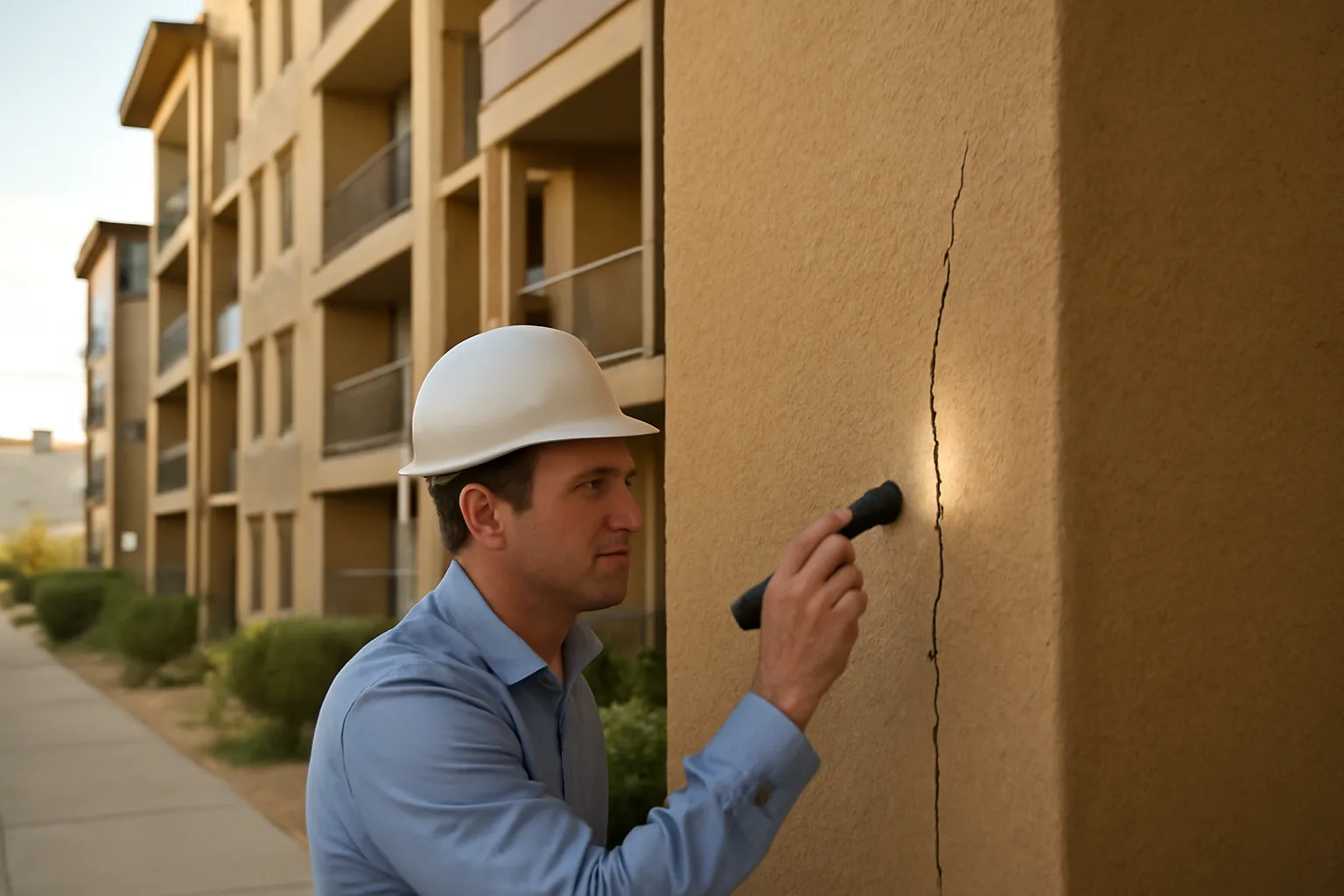
A reserve study is a physical inspection and financial analysis of a community's shared components, roofs, pavement, elevators, pools, siding, that estimates when each will need replacement and how much that will cost. A qualified professional walks the property, catalogs the major common elements, estimates remaining useful life for each, and builds a funding plan showing how much the association should be setting aside each year so the money is there when the roof or the parking structure actually needs replacing. Most reserve studies have two parts: the physical analysis (what needs replacing and when) and the financial analysis (how much is currently saved, how much is coming in, and whether that's enough). A good study doesn't just say "you need $2 million eventually." It builds a year-by-year funding schedule so the board can set assessments that avoid a surprise special assessment later. In Nevada, the statute uses the term "study of the reserves" rather than "reserve study," but it functions the same way industry-wide, and most Nevada management companies and reserve specialists use the same terminology as the rest of the country [1].
What does Nevada law actually require (NRS 116)?
Nevada's community association law lives in Nevada Revised Statutes Chapter 116, the Uniform Common-Interest Ownership Act. NRS 116.31152 is the core reserve statute, and it applies to condominiums, cooperatives, and planned communities alike, more than single-family HOAs. The statute requires the executive board to "conduct a study of the reserves required to repair, replace and restore the major components of the common elements" and to review that study, or have it reviewed, at least once every 5 years [1]. The board must also review the current reserve funding at least once a year and, if the reserve is underfunded, adjust the budget to address the shortfall. Unlike Florida's post-Surfside overhaul, Nevada's reserve study statute has been on the books in some form since the early 1990s and was significantly amended in 2003 and again in later sessions. It's not tied to a building age or height trigger. It applies broadly to associations governed by NRS 116, regardless of how tall the building is or how close it sits to Lake Tahoe or the Colorado River. The reserve study itself must be conducted or updated by someone Nevada considers "qualified," and the statute defines that term specifically, more than "an engineer" or "a contractor" in the abstract [1].
Who is a "qualified" reserve study preparer in Nevada?
NRS 116.310 and the associated regulations define a "reserve study specialist" narrowly. Nevada requires that the person preparing or updating the study either be a reserve study specialist certified by a recognized national reserve study organization, a registered architect, or a licensed engineer, among other qualifying credentials the Nevada Real Estate Division recognizes [1]. The Nevada Real Estate Division (a division of the Department of Business and Industry) oversees common-interest community law and licensing for community managers, and it publishes guidance and forms related to reserve requirements. Boards should check current NRED guidance before hiring anyone, because the list of accepted credentials has shifted over past legislative sessions. Practically, most Nevada associations hire firms that hold the Reserve Specialist (RS) designation from the Community Associations Institute or work with licensed engineers who specialize in reserve analysis. Cost and firm experience with Nevada's specific climate issues (freeze-thaw cycles in the mountains, extreme heat and UV degradation in Las Vegas and Reno) matter more than the credential alone.
How much should an HOA have in reserves?
There's no single dollar figure or percentage that applies to every association, and anyone who gives you a flat number like "10% of the budget" is oversimplifying. The right reserve balance depends entirely on the age, size, and component mix of the specific property, which is exactly why the study exists instead of a rule of thumb. That said, the industry commonly talks about "percent funded," meaning current reserve balance divided by the ideal reserve balance the study calculates for that point in time. Associations funded below 30% are generally considered at meaningfully higher risk of a special assessment within the next several years, according to reserve study industry benchmarks used by firms following National Reserve Study Standards published by Community Associations Institute [2]. Associations at 70% or higher are usually considered strong. Nevada law doesn't mandate a specific percent-funded target the way some states are starting to consider. It requires the study, requires the board to review funding annually, and requires the board to address underfunding in the budget, but it stops short of dictating a number. That leaves real discretion, and real risk, with the board. For context, Florida's post-Surfside reforms went further for condos: as of the 2022 and 2023 legislative changes, Florida associations 3 stories or higher must fund reserves at full, statutorily-defined levels for structural components identified in a Structural Integrity Reserve Study (SIRS), with very limited ability to waive or reduce that funding once the SIRS is done [1]. Nevada has no equivalent SIRS mandate. If you're comparing state approaches, see our breakdown of reserve study requirements generally and how Florida's SIRS regime differs.
How often must Nevada associations update the reserve study?
At least every 5 years, per NRS 116.31152(4), the board must have the reserve study reviewed and, if needed, updated by a qualified person [1]. Many associations choose to do a full study every 3 years with a lighter financial-only update in between, which is a common industry practice recommended by CAI's National Reserve Study Standards even where state law only requires 5 years [2]. The annual requirement is different and easier to miss: the board must review current reserve funding every year, even in years when a full study update isn't due. That annual review is a budget conversation, not a new inspection. It's where the board looks at the last study's schedule, checks whether contributions are on track, and adjusts the coming year's budget if they're falling behind. Boards that treat the 5-year update as the only checkpoint often end up scrambling. Costs move, materials prices spike, and a roof that was estimated at 12 years remaining life in 2021 might need attention sooner if storm damage or unexpected wear shows up. The annual review is the cheap insurance against that.
What happens if a Nevada association doesn't fund reserves properly?
Nevada doesn't impose criminal penalties for reserve underfunding the way some newer state laws threaten. But the practical consequences are still serious, and arguably more common than any statutory penalty would be. Underfunded reserves usually mean one of two things happens eventually: the association levies a special assessment (sometimes a large one, with little notice), or the board deprioritizes maintenance and lets components run past their useful life, which tends to cost more in emergency repairs than planned replacement would have. Neither outcome is good for owners trying to sell, since buyers' lenders and title companies increasingly ask for reserve study and reserve fund status as part of underwriting. Owners in Nevada common-interest communities can also raise reserve funding failures in disputes with the association, and chronic underfunding can become evidence in claims that the board breached its fiduciary duty under NRS 116.3103, which sets the standard of care for executive board members [2]. It's not automatic liability, courts look at the board's process and good faith, but a board that never commissioned a study or ignored one for a decade is in a much weaker position than one that followed the statute and made a documented, reasonable funding decision. For associations managing a special assessment after underfunded reserves catch up with them, our HOA special assessment guide walks through notice requirements and owner rights, though always check Nevada-specific rules with counsel since assessment procedures vary by state.
What is an HOA assessment (and how is it different from a reserve contribution)?
An HOA assessment is the fee an association charges owners to fund its operations and obligations, and it usually comes in two flavors: regular assessments and special assessments. Regular assessments are the recurring dues, monthly or quarterly, that cover both operating expenses (landscaping, insurance, management fees) and reserve contributions (the savings for future big-ticket replacements). A special assessment is a one-time, extra charge levied when the regular assessment and existing reserves aren't enough to cover a specific need, an unexpected roof failure, a lawsuit settlement, or a major project the reserve study flagged but the board didn't fund adequately in advance. Special assessments are usually the direct, visible cost of reserve underfunding: if the study says you need $500,000 for a roof in year 8 and the board only saved $150,000, the missing $350,000 typically shows up as a special assessment bill mailed to every unit owner. The distinction matters because reserve contributions inside the regular assessment are supposed to prevent special assessments. When a board consistently underfunds reserves to keep monthly dues artificially low (a common political pressure in HOAs), it's essentially borrowing against future owners' wallets in the form of a bigger, less predictable bill down the road.
How much does a reserve study cost?
Reserve study costs vary by association size and component complexity, but a reasonable range for most condo and HOA communities is roughly $3,000 to $10,000 for an initial full study, with smaller associations at the low end and larger, more complex properties (multiple buildings, elevators, pools, extensive site work) running higher [2]. Update studies without a full site visit are typically cheaper, often in the $1,000 to $3,000 range, though pricing depends heavily on the firm and region. Florida's newer SIRS requirement, which applies specifically to condo buildings 3 stories or taller, tends to cost more than a generic HOA reserve study because it requires a licensed engineer or architect to inspect specific structural components (load-bearing walls, roofs, primary structural systems, waterproofing) under Florida Statutes 718.112(2)(g) [3]. SIRS costs commonly run from around $5,000 for smaller buildings into the tens of thousands for large, complex high-rises, though DBPR does not publish a standard fee schedule and actual bids vary by engineering firm and building size [4]. Nevada doesn't have a SIRS-equivalent structural inspection mandate layered on top of the general reserve study requirement, so Nevada condo reserve studies tend to track the lower, general-HOA cost range rather than Florida's structural-inspection premium. Boards should always get multiple bids; reserve study costs for similar-sized buildings can vary by thousands of dollars between firms.
How does Nevada's law compare to Florida's SIRS and milestone requirements?
| Applies to | All common-interest communities (condos, co-ops, planned communities) | Condos 3+ stories (SIRS); all condos for general reserves | |
|---|---|---|---|
| Study frequency | At least every 5 years | SIRS at least every 10 years; milestone inspection at 25/30 years | |
| Who can prepare it | Reserve study specialist, registered architect, licensed engineer, or other NRED-recognized credential | Licensed engineer or architect for SIRS | |
| Funding mandate | Board must address underfunding annually; no fixed statutory minimum | Full funding of SIRS components required, waivers largely eliminated as of 2023 reforms | |
| Structural inspection tied to age/height | No | Yes: milestone inspection at 25 years (30 if not on coast) and SIRS components tied to structural condition | |
| Penalty for noncompliance | Civil/fiduciary duty exposure under NRS 116.3103 | Statutory funding mandate; DBPR enforcement authority | Florida's approach is unusually strict nationally. Most states, Nevada included, require the study and require the board to consider it, but leave the actual funding level to board discretion. Florida essentially removed that discretion for structural components after Surfside, requiring full funding with no waiver option for SIRS-covered items under the 2022 and 2023 statutory changes to Florida Statutes 718.112 [1] [3]. If your association owns property in both states, or you're a snowbird board member comparing rules, it's worth reading our full reserve study for condo association explainer and the Florida condo reserve fund relief piece covering recent legislative adjustments to Florida's funding timeline. |
Florida and Nevada both require reserve studies, but they differ sharply in scope, trigger, and enforcement, largely because Florida rewrote its condo law after the 2021 Champlain Towers South collapse in Surfside. | Feature | Nevada (NRS 116) | Florida (Ch. 718) |
Are HOA special assessments tax deductible?
Generally, no, not for the typical owner-occupant. Special assessments used for capital improvements or major repairs to common elements are usually treated like a capital expenditure added to your cost basis in the property, not a deductible expense, according to general IRS guidance on home ownership and improvements . That means it can reduce your taxable gain when you eventually sell, but it doesn't reduce your taxable income the year you pay it. There are exceptions. If you rent out your unit, special assessments related to repairs (as opposed to improvements) on the rental portion may be deductible as a business expense, and assessments tied to capital improvements on a rental property are typically depreciated over time rather than deducted immediately. If a special assessment relates to a casualty loss, like storm damage in a federally declared disaster area, different rules under IRS casualty loss provisions may apply. This isn't tax advice, and the treatment depends on your specific situation, whether the unit is your primary residence, a rental, or a mix, and what the assessment actually paid for. Talk to a CPA or tax attorney before assuming either way, especially for a large assessment.
What should a Nevada condo board actually do to stay on track?
Start with the calendar. Nevada law's clearest, easiest-to-miss requirement is the annual reserve funding review, separate from the 5-year study update. Put both dates in the board's permanent record, more than in one manager's inbox, so a management company change doesn't cause a missed deadline. Next, get bids from at least two or three qualified reserve study specialists before the current study lapses, not after. Studies take weeks to schedule and complete, and a board that waits until month 59 of a 60-month window often ends up rushing the process or paying a premium for expedited work. Third, document the annual review decision in board minutes, even in years when the answer is "reserves are on track, no budget change needed." That paper trail matters if an owner later challenges the board's funding decisions under the fiduciary duty standard in NRS 116.3103 [2]. Finally, treat the reserve study as a communication tool with owners, more than a compliance checkbox. Owners who understand why reserves need to grow are far less likely to fight rational dues increases, and far more likely to support the board when a special assessment genuinely can't be avoided. A well-organized compliance calendar, tracking the 5-year study, the annual review, and any related deadlines in one place, is exactly the kind of administrative work a $199 Building-Specific Board Compliance Kit is built to handle: it doesn't replace the licensed reserve specialist or engineer the statute requires, but it keeps the board from missing the dates that matter. See our board-kit-builder for details, or start with the general HOA reserve study explainer if you're comparing state frameworks before deciding what your board needs.
Frequently asked questions
What is a reserve study?
A reserve study is a physical and financial analysis, done by a qualified specialist, engineer, or architect, that inventories an association's major common elements, estimates their remaining useful life, and calculates how much money the association should save each year to replace them without a surprise special assessment.
What is a reserve study for an HOA?
For an HOA, a reserve study covers shared components the association is responsible for, roofs, roads, pools, clubhouses, fencing, depending on the community. It produces a funding schedule the board uses to set annual dues so major repairs don't force a sudden special assessment on owners.
What is an HOA assessment?
An HOA assessment is a fee owners pay to the association, either a recurring regular assessment covering operations and reserve contributions, or a one-time special assessment charged when reserves and regular dues can't cover a specific major expense, like an unplanned roof replacement or a legal settlement.
How much should an HOA have in reserves?
There's no universal dollar figure; it depends on the property's age, size, and components, which is what the reserve study calculates. Industry benchmarks generally treat associations funded below 30% of the study's ideal reserve level as higher risk for a near-term special assessment, per CAI reserve study standards.
How much does a reserve study cost?
A full initial reserve study for most condo or HOA communities typically costs between $3,000 and $10,000, depending on size and complexity, with smaller associations at the lower end. Update studies without a full site visit are usually cheaper, often $1,000 to $3,000, though pricing varies by firm and region.
Are HOA special assessments tax deductible?
Generally not for a primary residence; special assessments for capital improvements typically add to your cost basis rather than being deductible in the year paid. Rental property owners may get different treatment for repair-related assessments. Confirm your specific situation with a CPA, since IRS treatment depends on the assessment's purpose and how the unit is used.
Does Nevada require reserve studies for condos like Florida does?
Yes, but less strictly. Nevada requires a reserve study at least every 5 years under NRS 116.31152 for all common-interest communities, condos included, with annual funding reviews. Unlike Florida, Nevada has no SIRS-style mandatory full funding rule tied to building height or age.
Who can legally perform a reserve study in Nevada?
Nevada requires the study be prepared or reviewed by a qualified person, generally a reserve study specialist certified by a recognized national organization, a registered architect, or a licensed engineer, per NRS 116.310 and Nevada Real Estate Division guidance. Boards should confirm current accepted credentials with NRED before hiring.
What happens if a Nevada HOA board ignores the reserve study requirement?
There's no criminal penalty, but ignoring the requirement or chronically underfunding reserves can expose board members to fiduciary duty claims under NRS 116.3103, and practically leads to large special assessments or deferred maintenance that costs more later. Documentation of a good-faith annual review helps protect the board.
How often does Nevada require reserve study updates?
At least every 5 years for a full review or update by a qualified specialist under NRS 116.31152. Separately, the board must review current reserve funding at least once a year, even in years a full study update isn't due, and adjust the budget if reserves are falling behind.
Is Nevada's reserve study law the same as Florida's SIRS law?
No. Florida's SIRS law applies specifically to condo buildings 3 stories or taller, requires a licensed engineer or architect's structural inspection, and largely eliminates funding waivers for covered components. Nevada's law is broader in scope (all common-interest communities) but has no comparable structural-inspection mandate or forced full-funding rule.
What's the difference between a regular assessment and a special assessment?
A regular assessment is the recurring dues owners pay, covering operating costs and reserve contributions. A special assessment is a one-time extra charge levied when the regular budget and reserves can't cover a specific need, often signaling that reserves were underfunded relative to what the reserve study recommended.
Sources
- Nevada Legislature, NRS Chapter 116: Nevada's community association law is codified in NRS Chapter 116, the Uniform Common-Interest Ownership Act
- Florida Senate, Florida Statutes 718.112: Florida's 2022-2023 reforms require full funding of SIRS components and largely eliminate reserve funding waivers
- Florida DBPR, Division of Florida Condominiums, Timeshares, and Mobile Homes: DBPR oversees Florida condominium reserve and SIRS compliance but does not set a standard SIRS fee schedule
- Internal Revenue Service, Publication 530, Tax Information for Homeowners: Special assessments for capital improvements are generally treated as additions to cost basis rather than deductible expenses
- Nevada Legislature: NRS 116.31083 sets the requirement for associations to conduct a study of the reserves and update it periodically.
- Nevada Legislature: NRS 116.31152 outlines requirements for the reserve study and who may prepare it.
- Nevada Legislature: NRS 116.31151 requires associations to prepare and distribute an annual budget that accounts for reserve funding.
- Nevada Real Estate Division (Common-Interest Communities): Nevada's Real Estate Division regulates common-interest communities and oversees compliance with reserve study requirements under NRS 116.
- Florida Senate: Florida's statute establishes structural integrity reserve study (SIRS) requirements for condominium associations.
- Florida Senate: Florida's milestone inspection law requires structural inspections of aging condominium buildings.
- Internal Revenue Service: IRS guidance explains that personal expenses, including most HOA assessments, are generally not tax deductible.