Last updated 2026-07-24
TL;DR
Florida law (Fla. Stat. 553.899) requires milestone structural inspections for condo and co-op buildings 3+ stories, generally by 30 years old (25 years if within 3 miles of the coast), then every 10 years. Palm Beach County's entire coastline falls under the 25-year rule. Phase 1 inspections typically run $3,000 to $15,000+ depending on building size; Phase 2, if required, costs far more.
What is a milestone inspection, and why does Palm Beach County have an earlier deadline?
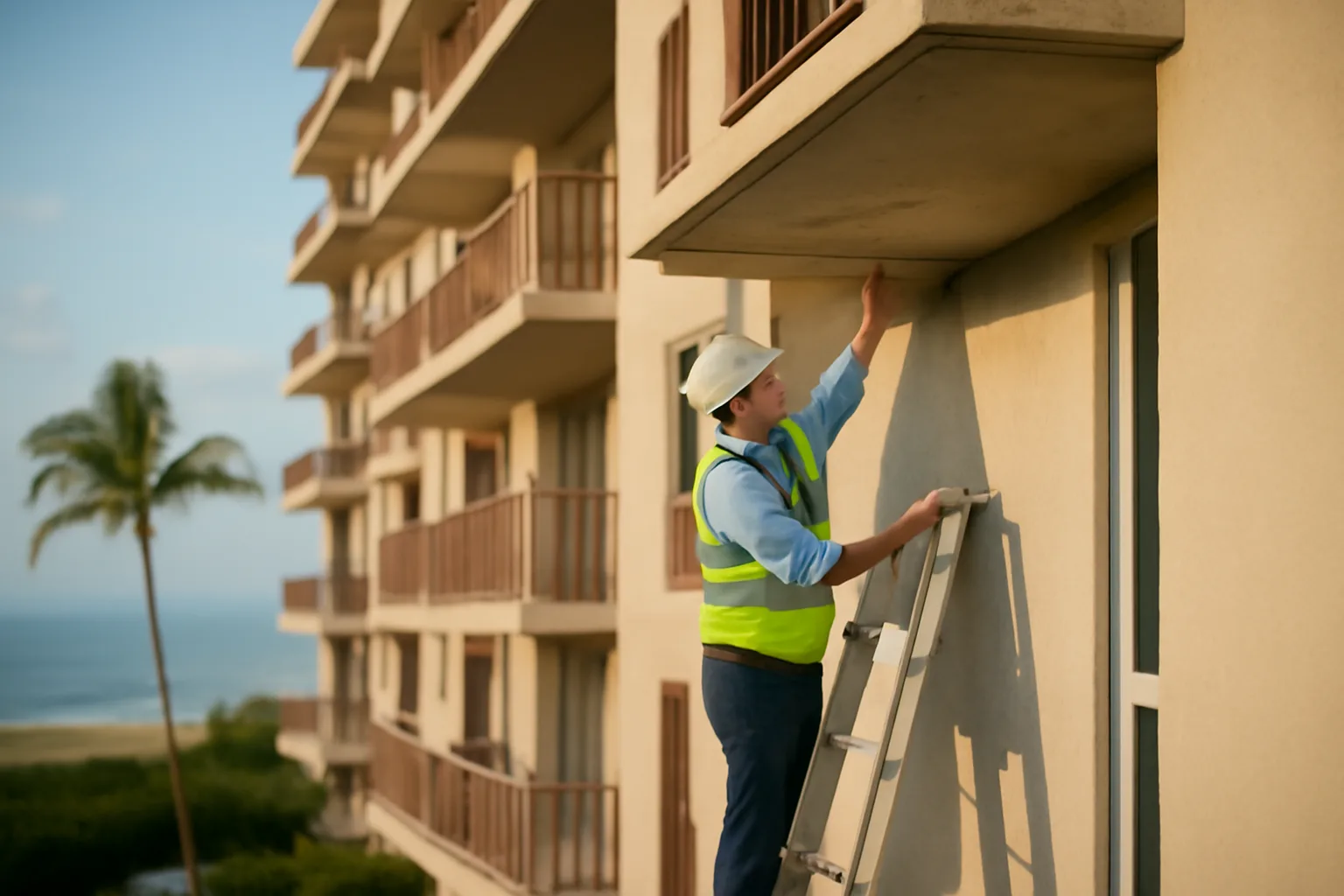
A milestone inspection is a structural review, done by a licensed Florida architect or engineer, of a condominium or cooperative building three stories or taller. The law was passed in 2022 after the Champlain Towers South collapse in Surfside, and it lives in Fla. Stat. 553.899. It requires a Phase 1 visual inspection of the building's structure, and if the inspector finds "substantial structural deterioration," a Phase 2 inspection follows, which can include destructive testing like core sampling and opening up walls or slabs. The deadline trigger is age, but the law shortens the clock for coastal buildings. Under 553.899(3), buildings must get their first milestone inspection by the time they turn 30 years old, except buildings located within three miles of a coastline, which must be inspected at 25 years [1]. After the initial inspection, it repeats every 10 years. Here's the part that matters most for Palm Beach County boards: virtually every incorporated area along the Atlantic, from Jupiter down through Boca Raton, sits within that 3-mile coastal band. That means most 3+ story condo buildings in Palm Beach County are on the 25-year schedule, not the 30-year one. If your building's certificate of occupancy is from 2001 or earlier, you're likely already past due or coming due soon, and you should confirm your exact age trigger with your local building official rather than guess.
How does Palm Beach County (and its cities) actually implement the deadline?
The statute sets the floor, but local building officials administer it, and Palm Beach County has its own notice and enforcement process layered on top of state law. The county's Building Division and individual municipalities (Boca Raton, West Palm Beach, Delray Beach, Boynton Beach, Palm Beach itself, and others) each send notices to buildings as they approach their milestone age, but boards should not wait for a letter. The statute makes the inspection the building's obligation regardless of whether the local government sends a reminder. Many Palm Beach County cities require the inspection report, or at least a summary/statement of Phase 1 completion, to be filed with the local building department within a set window after the inspector completes the report. Some cities have adopted stricter local timelines or additional submission requirements under their home rule authority. Because these local rules shift and vary city by city, confirm the specific filing deadline and required documentation with your city or county building official and your association's counsel before you assume state law alone tells you the whole timeline. Under Fla. Stat. 553.899(4), the local enforcement agency is the one that determines a building is due for inspection, notifies the owner in writing, and can require the owner to submit the required inspection report within the timeframes the local agency sets, so the mechanics of notice and filing genuinely run through your city or county building department, not a state agency [1].
What's the actual cost difference between Phase 1 and Phase 2 inspections?
| Phase 1 | Visual inspection of accessible structural elements | $3,000 to $15,000+ | Licensed FL architect or engineer | |
|---|---|---|---|---|
| Phase 2 | Destructive/invasive testing where deterioration is found | Highly variable, often tens of thousands+ | Licensed FL architect or engineer | Boards sometimes get sticker shock at the idea that Phase 1 is "just a walk-through" for several thousand dollars. It isn't just a walk-through. The engineer is putting a license on the line certifying the structural condition of a building people live in, and that report becomes a legal and financial reference point for years. |
Phase 1 is a visual inspection: a licensed engineer or architect walks the property, looks at accessible structural elements (balconies, the roof, parking structures, exterior walls), and writes a report. For a typical mid-size condo building, Phase 1 costs commonly run $3,000 to $15,000, though larger or more complex buildings (multiple towers, large parking garages, extensive coastal exposure) can run higher. There's no statewide fee schedule; pricing depends on square footage, number of structural elements, and the engineering firm. Phase 2 is triggered only when Phase 1 finds "substantial structural deterioration," a term the statute doesn't define with a bright-line test, which is why two different engineers can reasonably disagree on whether a finding rises to that level. Phase 2 can include core sampling of concrete, laboratory testing, and more invasive investigation of areas the Phase 1 report flagged. Costs vary enormously depending on scope, but boards should budget for the possibility that Phase 2, if required, could run into the tens of thousands of dollars or more, on top of whatever repairs the findings recommend. | Phase | What it involves | Typical cost range | Who does it |
How does the milestone inspection interact with Florida's SIRS requirement?
They're related but not the same document, and boards mix them up constantly. The milestone inspection under 553.899 is a structural safety check tied to building age. The Structural Integrity Reserve Study (SIRS), required under Fla. Stat. 718.112(2)(g), is a reserve-funding study that a licensed engineer or architect (or other qualified professional per the statute) must complete at least every 10 years, and it must address specific components: roof, load-bearing walls, primary structural members, floor, foundation, fireproofing/fire protection, plumbing, electrical, and waterproofing, among others named in the statute [2]. A milestone inspection often uncovers findings that then need to be reflected in the SIRS funding numbers, since the SIRS has to project the cost of replacing or maintaining those structural components over their useful life. Many engineering firms in South Florida now offer combined milestone/SIRS site visits since an engineer is already on the roof and in the garage anyway, and that combined approach can save the association a second mobilization fee, though it doesn't mean the two reports collapse into one legal obligation. Boards should treat these as two separate statutory clocks that happen to be easiest to satisfy together. If you want more background on what a SIRS actually has to cover and how associations budget against it, see reserve study and hoa reserve study.
What is a reserve study, and what is it for?
A reserve study is an engineering and financial analysis that identifies an association's major common-element components, estimates their remaining useful life, and calculates how much money the association needs to set aside each year so it can pay for repair or replacement without a surprise special assessment. In Florida condo law, the SIRS version (Fla. Stat. 718.112(2)(g)) is now mandatory for most condo buildings 3 stories or taller, and it must be based on a visual inspection performed by a licensed engineer or architect [2]. A reserve study for an HOA (as opposed to a condo) is not currently mandated by the same statute in the same way, since 718.112 governs condominiums specifically; HOAs fall under chapter 720, which has its own, generally less prescriptive reserve rules. That said, the underlying financial logic is identical: without a funded reserve schedule, an HOA board is gambling that nothing big breaks before the roof, road, or clubhouse needs replacing. The core output of any reserve study is a component list with age, useful life, and replacement cost, paired with a funding plan (often "full funding," "threshold funding," or "baseline funding" models) that spreads the cost over years instead of dumping it on owners all at once.
How much does a reserve study cost?
Costs vary by building size, number of components, and whether it's a full SIRS-compliant engineering study or a simpler financial-only reserve analysis. As a rough range reported by Florida engineering and reserve-study firms, a basic reserve study for a small to mid-size association can run roughly $3,000 to $7,000, while a full SIRS engineering study for a larger high-rise with multiple structural systems, parking garages, and waterproofing components can run considerably higher, often into the five figures. There's no statewide fee schedule for this, so any number you hear is a market estimate, not a legal figure. Get at least two or three quotes from licensed Florida engineers or reserve specialists, and ask specifically whether the quote satisfies the 718.112(2)(g) SIRS requirements, since a generic reserve study from an accounting-only provider will not meet the engineering-inspection standard the statute now demands. For a deeper walkthrough of what's in a compliant SIRS study, see reserve study for condo association.
How much should an HOA (or condo) have in reserves?
There's no single dollar figure that's "right," because it depends entirely on your components, their age, and their replacement cost. The honest answer is: enough to match what your reserve study (or SIRS) says you'll need, funded on a schedule that avoids a cliff-edge special assessment. For Florida condominiums subject to the SIRS law, the statute effectively answers this for the structural components: associations must reserve based on the SIRS study's calculated amounts for the listed structural items, and boards can no longer vote to waive or reduce reserves for those specific SIRS components the way they historically could for general reserves under 718.112(2)(f) [2]. For non-SIRS components (paint, landscaping, amenities) and for HOAs generally, funding levels are more of a board policy decision, guided by whatever reserve study the board commissions. A reasonable rule of thumb some reserve professionals use: if your reserve study shows you're funded below roughly 30% of the "fully funded" benchmark for your components, you're at meaningfully elevated risk of a special assessment within the next 5 to 10 years. That's an industry heuristic, not a statutory line, so don't quote it as law.
What is an HOA assessment, and how is it different from a special assessment?
A regular HOA (or condo) assessment is the routine periodic charge, monthly or quarterly, that every owner pays to cover operating expenses and reserve contributions. It's the association's baseline revenue, set in the annual budget. A special assessment is a separate, additional charge the board levies outside the normal budget, usually to cover an unexpected or underfunded cost, like a milestone-inspection-triggered repair, a Phase 2 finding, storm damage not covered by insurance, or a reserve shortfall the association didn't see coming. Special assessments require board action under the association's governing documents and Florida statute, and depending on the size and the documents, may require specific notice to owners. Milestone inspections are one of the more common triggers for special assessments right now in Palm Beach County, precisely because so many buildings are hitting their 25-year or 30-year deadline at the same time and discovering deferred maintenance that reserves didn't cover. If your board is facing one, hoa special assessment walks through notice requirements and payment-plan options, and condo special assessment insurance covers what parts of a big assessment, if any, insurance might offset.
Are HOA special assessments tax deductible?
For most owners, no. Special assessments for capital improvements, structural repairs, or reserve shortfalls are generally treated by the IRS as additions to the cost basis of your unit, not as a deductible expense, because they're capital in nature rather than a deductible operating cost. This mirrors the general federal tax treatment of home improvement costs. There are narrow exceptions. If you rent out the unit as investment or rental property, a portion of certain assessments tied to repairs (as opposed to improvements) may be deductible as a rental expense, and capital-improvement assessments on a rental unit may be depreciable over time. This is genuinely fact-specific and depends on IRS rules distinguishing repairs from capital improvements: IRS Publication 527 explains that "you can deduct the costs of certain materials, supplies, repairs, and maintenance that you make to your rental property to keep your property in good operating condition," while amounts that improve the property must generally be capitalized and depreciated [3]. Owner-occupants should not assume any deduction applies, and everyone should talk to a CPA or tax preparer before claiming anything, since board-level guidance (including this article) isn't tax advice.
What should a Palm Beach County board do in the 12 months before a milestone inspection is due?
Start by confirming your exact trigger date with your city or county building official, since "25 years from certificate of occupancy" sounds simple until you're digging through old permit records to find the actual CO date. Don't rely on memory or an old closing disclosure. Next, get quotes from at least two or three licensed Florida engineering firms that do both milestone inspections and SIRS work, since a combined visit often saves money and scheduling headaches. Ask each firm directly what their turnaround time is; in high season (winter, when a huge share of South Florida's licensed structural engineers are booked solid), scheduling delays of 60 to 90 days are common, so don't wait until the month you're due. Build communication into the timeline from day one. Owners will have questions about cost, about whether a special assessment is coming, and about what "substantial structural deterioration" means if Phase 1 flags something. Boards that get blindsided by owner anger usually aren't hiding information, they're just disorganized about sharing it on a schedule. This is the kind of scheduling and document-tracking gap that a Building-Specific Board Compliance Kit is built to close for $199 one-time: it organizes your building's specific deadlines, tracks required filings, and gives you a communication template for owners, so the board isn't reconstructing the timeline from scratch under pressure. It doesn't replace your engineer's inspection or your attorney's read of your documents; it just keeps the paperwork and dates straight.
What happens if a Palm Beach County building misses its milestone inspection deadline?
The statute doesn't spell out a single statewide penalty schedule for missing the deadline; enforcement runs largely through local building officials, who can require compliance, and through the association's own liability exposure if a structural problem goes undetected and causes harm. Some cities in Palm Beach County have adopted local enforcement mechanisms, including fines or building-safety orders, for associations that fail to complete or file required inspections. Beyond direct enforcement, missing the deadline creates real practical risk: insurers increasingly ask about milestone and SIRS compliance status during underwriting and renewal, and a building that can't show a current report may face higher premiums, non-renewal, or exclusions. Buyers' lenders and title companies are also asking more often for milestone/SIRS status before closing, so a missed deadline can freeze unit sales in the building. Because enforcement varies by city and because insurance and lending practices are evolving quickly, confirm your building's specific exposure with your association's counsel and your local building department rather than assuming a generic statewide answer applies.
Does reserve funding relief apply to Palm Beach County condos?
Florida has periodically considered or passed limited relief measures affecting reserve funding timelines and requirements, given how many associations statewide were caught unprepared by the 2022 reforms. These provisions change based on legislative sessions, so any specific relief mechanism (delayed start dates, phased funding, alternative financing options) needs to be verified against the current statute text and any amendments, not assumed from an older article or news story. For the latest detail on what relief measures exist and who qualifies, see florida condo reserve fund relief, and confirm current status with your association's counsel, since this is an area the legislature revisits almost every session.
Frequently asked questions
What is a reserve study?
A reserve study is an analysis, usually done by an engineer or reserve specialist, that lists an association's major common-element components, estimates their remaining life, and calculates the annual funding needed to replace them without a surprise special assessment. Florida's SIRS version, required under Fla. Stat. 718.112(2)(g), must be based on a licensed engineer or architect's visual inspection.
What is a reserve study for an HOA?
For an HOA, a reserve study serves the same purpose as it does for a condo: identifying components (roofs, roads, pools, clubhouses) and projecting replacement costs and timing so the board can fund reserves gradually. HOAs fall under Fla. Stat. chapter 720, which is generally less prescriptive than the condo SIRS rules in chapter 718, so requirements can differ by governing documents.
What is an HOA assessment?
An HOA assessment is the periodic fee owners pay to fund the association's operating budget and reserves, typically billed monthly or quarterly. It's distinct from a special assessment, which is an extra, one-time or short-term charge levied outside the regular budget, often to cover an unexpected cost like a milestone-inspection repair.
How much should an HOA have in reserves?
There's no single statewide dollar figure; the right amount is whatever your reserve study calculates for your specific components and their replacement costs. For Florida condos, SIRS-covered structural components can no longer have reserves waived or reduced by owner vote once the SIRS study sets the funding level, per Fla. Stat. 718.112(2)(f)-(g).
How much does a reserve study cost?
Basic reserve studies for smaller associations often run roughly $3,000 to $7,000, while full SIRS-compliant engineering studies for larger high-rises with multiple structural systems can cost considerably more, sometimes into the five figures. Get quotes from at least two or three licensed Florida engineers, since there's no fixed statewide fee.
Are HOA special assessments tax deductible?
Generally no for owner-occupants. Special assessments for capital repairs or improvements typically add to your unit's cost basis rather than qualify as a deductible expense. Rental property owners may have narrow deduction or depreciation options depending on IRS rules distinguishing repairs from capital improvements (see IRS Publication 527); talk to a CPA before assuming any deduction applies.
When is a milestone inspection due for a Palm Beach County condo?
Buildings within three miles of the coast must complete their first milestone inspection by 25 years after the certificate of occupancy; buildings farther inland get 30 years. Because nearly all of Palm Beach County's coastal municipalities fall within that 3-mile band, most Palm Beach County condo buildings are on the 25-year schedule under Fla. Stat. 553.899.
What triggers a Phase 2 milestone inspection?
A Phase 2 inspection is required only if the Phase 1 visual inspection finds "substantial structural deterioration," a term Fla. Stat. 553.899 doesn't precisely define with a numeric threshold. The licensed engineer or architect makes that determination, which is why findings can vary somewhat between inspectors on borderline cases.
Is the SIRS the same as the milestone inspection?
No. The milestone inspection (Fla. Stat. 553.899) is a structural safety check triggered by building age. The SIRS (Fla. Stat. 718.112(2)(g)) is a reserve-funding study covering specific structural components, required at least every 10 years. Many firms combine site visits for both, but they're separate legal obligations.
Who can perform a milestone inspection in Florida?
Only a licensed Florida architect or engineer can perform a milestone structural inspection under Fla. Stat. 553.899. Community association managers and boards cannot self-certify; DBPR regulates the CAM licensing side but does not itself conduct or approve inspection reports.
What happens if my building fails or delays its milestone inspection?
Enforcement runs mainly through local building officials in Palm Beach County cities, which can vary in fines or compliance orders. Practically, insurers and mortgage lenders increasingly check milestone/SIRS status during underwriting, so a missed deadline can also raise premiums or stall unit sales even before any formal local enforcement action.
Can a Palm Beach County association delay a special assessment triggered by a milestone inspection?
Some associations explore payment plans, lines of credit, or phased repair schedules instead of one lump-sum assessment, but options depend on the association's governing documents, lender terms, and the urgency of the structural finding. This is a decision for the board with its attorney and engineer, not a general rule that applies to every building.
Sources
- Florida Senate, Florida Statutes 553.899: Milestone inspection age triggers of 30 years generally, 25 years within 3 miles of a coastline, the 10-year repeat cycle, and local enforcement agency notice/filing role
- Florida DBPR, Division of Florida Condominiums, Timeshares, and Mobile Homes: DBPR's regulatory role over condominium associations and community association managers
- Florida Senate, Florida Statutes 718.112: SIRS requirement, listed structural components, and the removal of the ability to waive reserves for SIRS components
- Internal Revenue Service, Publication 527 (Residential Rental Property): Tax treatment distinguishing deductible repairs from capital improvements for rental property owners
- Florida Senate, Florida Statutes 718.113: Statutory framework governing common element maintenance and repair obligations that underlie special assessment authority for structural repairs
- Florida Senate, Florida Statutes 720.303: HOA board meeting, budgeting, and special assessment procedural requirements under chapter 720